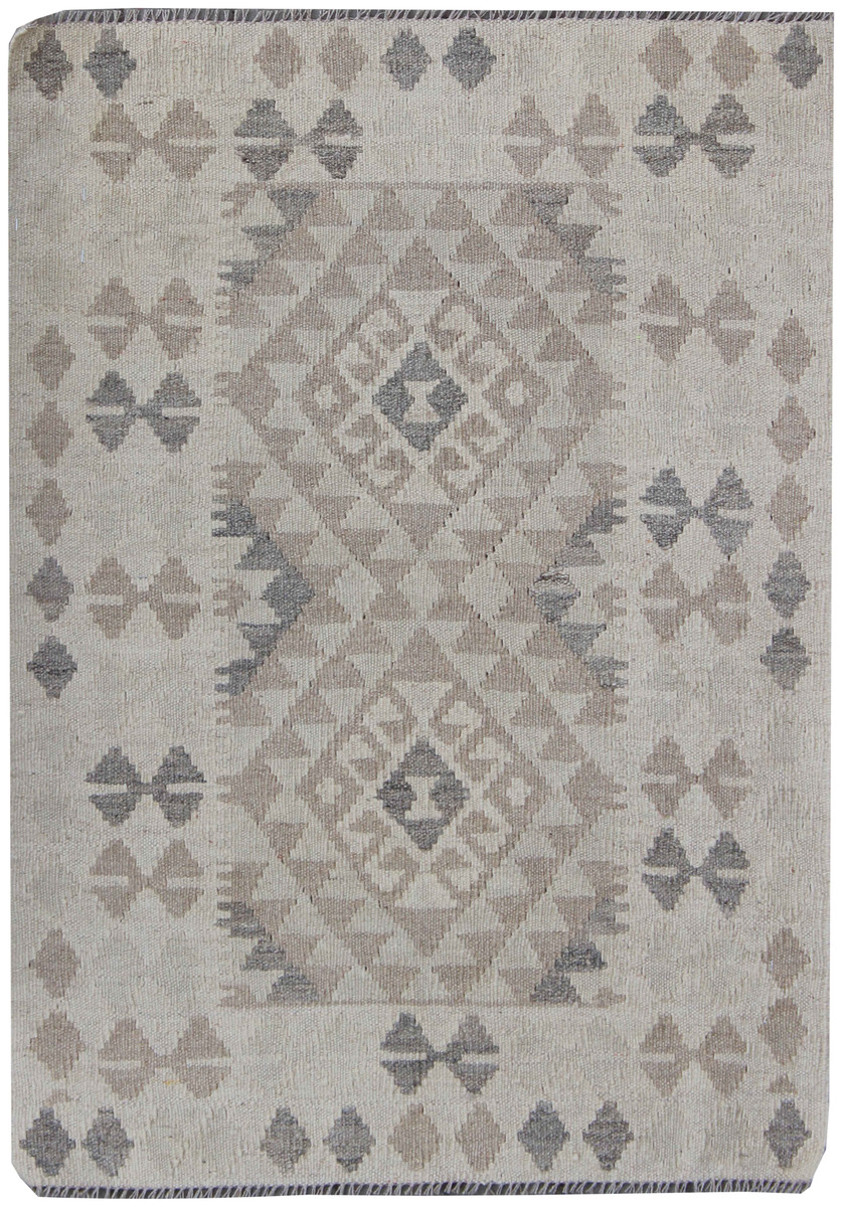
Rows of small lozenges mark the ends of this rug, enclosing a pair of more elaborate diamond medallions. The central figures have several pale and grey outlines, with tiny triangular projections breaking their edges. Darker small centres give them definition. Paired angular forms occupy the side spaces, their colours alternating between taupe, grey and shades close to the ivory ground. The pattern is detailed but lightly drawn. Pale outlines sometimes merge with the background before becoming distinct again beside a darker mark.
Fine horizontal streaks pass through the field, supplying a quiet visual texture beneath the geometry. The end lozenges are among the clearest elements, providing a simple repeated shape against the more intricate medallions. Afghan geometric textiles include both floor coverings and smaller household furnishings, with designs adapted to the dimensions and use of each object. Lozenges can become tiny scattered accents or expand into nested central figures. Both treatments appear here, giving this compact rug a useful contrast between relatively simple edging and a layered interior.
At 111 × 77 cm, this rug would suit a narrow open space beside a bed or a chair. A pale wood floor would keep the overall effect soft, while a darker floor would make the ivory ground more apparent. Cream fabric and a small grey accent could repeat its limited palette. Keeping the ends uncovered would preserve the little lozenge rows that give the composition its gentle finish.