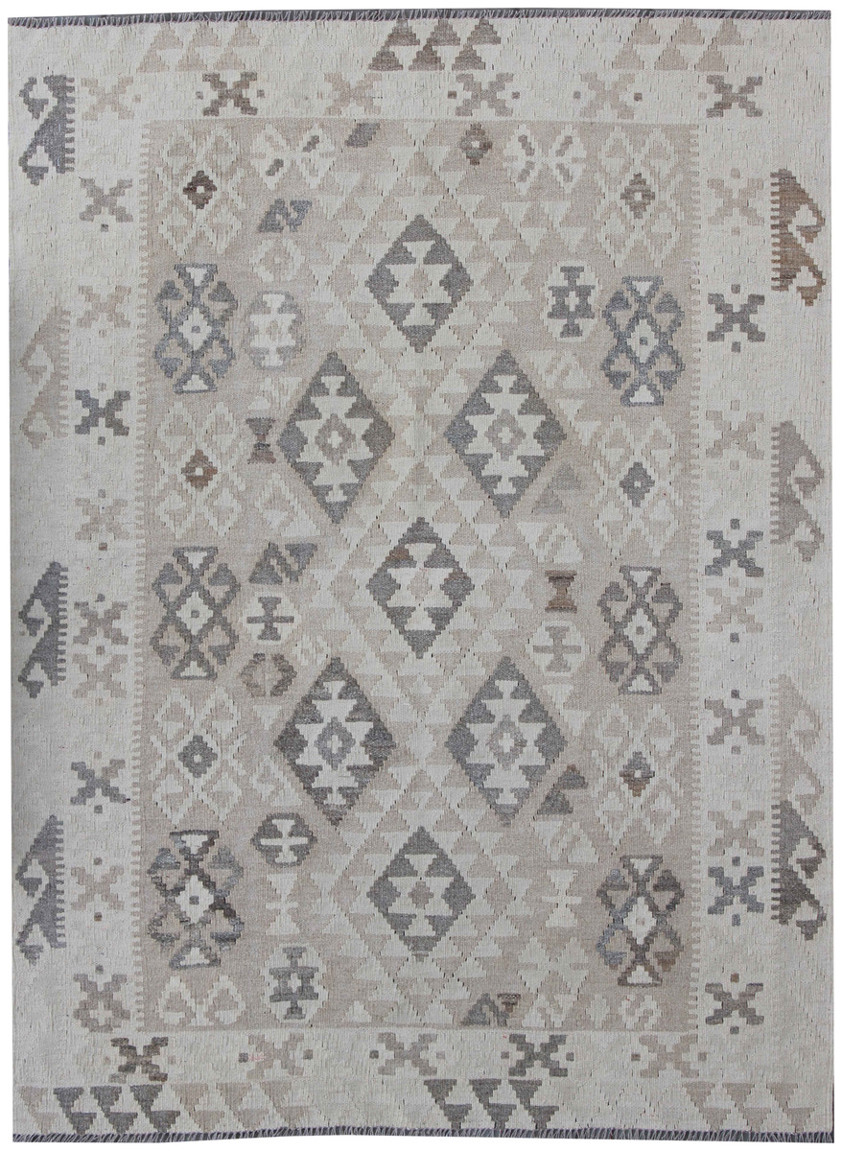
A lattice of large and small diamonds occupies the middle of this rug. Grey outlines surround pale geometric centres, with some compartments appearing darker and more prominent than their neighbours. Smaller linked figures run down the side areas, accompanied by little crosses and compact angular shapes. A light rectangular frame separates this busy interior from the more widely spaced motifs near the perimeter. The palette moves between ivory, beige and grey rather than relying on strong colour contrasts. Dark accents are concentrated in the central diamonds and a handful of outer figures.
Fine streaks through the ground soften the differences between the individual shapes, while the stepped outlines keep the drawing clear. Measuring 170 × 124 cm, this rug would work well in a study or a modest sitting area. A plain grey chair could echo the stronger centres, while natural oak would pick up the warmer background. Keeping some of the outer frame exposed would help the central lattice read as a distinct composition within the wider surface.
Afghanistan's household textile traditions make extensive use of geometric arrangements, with related motifs appearing on both rugs and smaller furnishings. Diamonds can be linked, nested or set within larger frameworks, producing considerable variety from a simple outline. This rug combines several of those possibilities. Its central lattice supplies continuity, while crosses, paired figures and partial motifs at the edges introduce a less regular counterpoint around it.