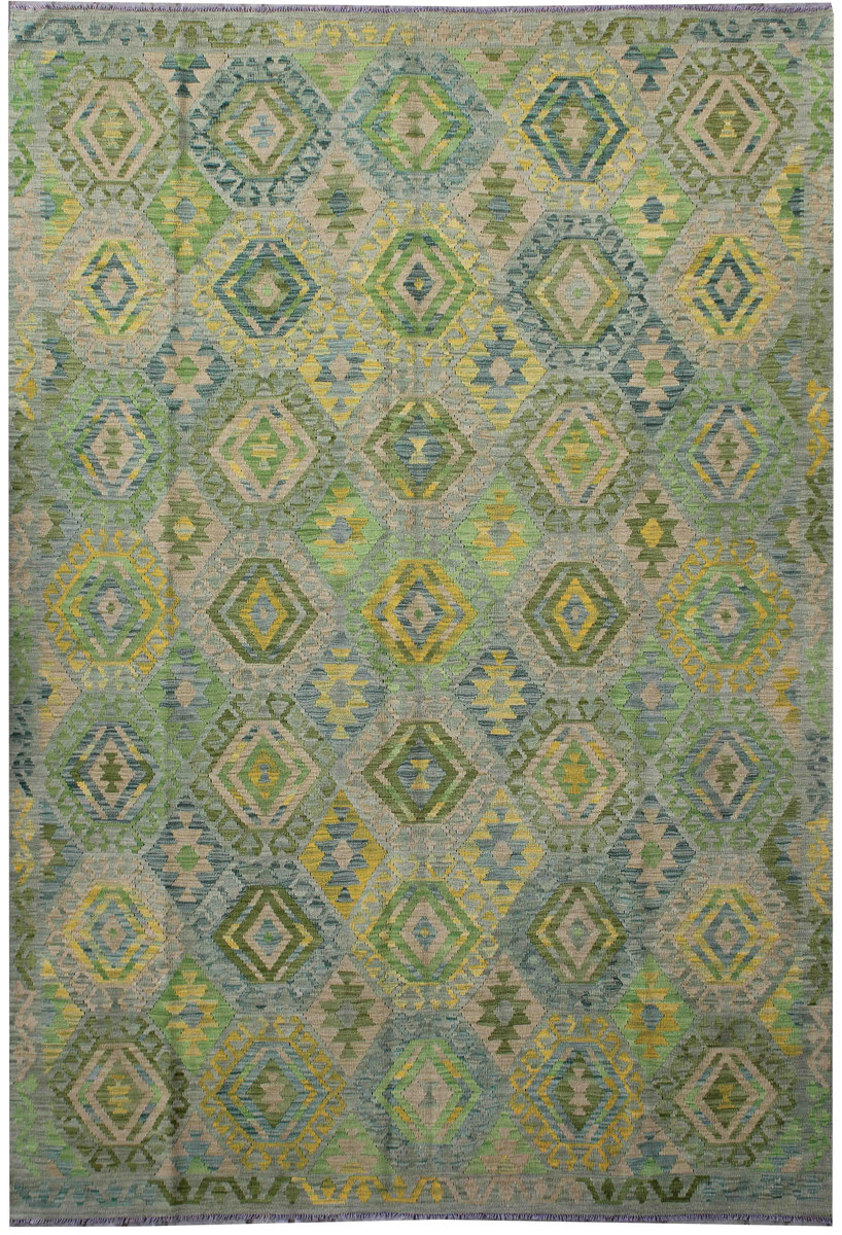
Rows of green hexagonal medallions organise the field of this rug. Yellow and cream appear within their nested outlines, with smaller lozenges and angular figures filling the intervals. The background varies between soft green, pale blue and warmer yellow, linking the compartments without a sharp dark framework. A narrow patterned border completes the rectangle. The repeated arrangement gives the rug an even decorative rhythm. At 300 × 202 cm, it would suit a generous seating group, particularly with cream upholstery and natural timber.
Muted green fabrics would connect with the principal forms, while a little yellow could bring forward the warmer centres. A small table could overlap the middle while leaving several complete medallions on view around it. Afghan kilims belong to a domestic weaving culture in which angular motifs appear on floor coverings and other household articles. A compartment can act as an independent medallion or become one unit within a repeating field. This example takes the latter approach, allowing related hexagons to carry the design throughout the interior.
Fine horizontal colour changes give the quieter areas a visible textile grain. The nested centres become more apparent close to the surface, revealing subtle differences between neighbouring forms. The smaller intervening marks also play an important part, keeping the spaces active without competing with the larger outlines and preserving the overall order of the repeated geometric field.