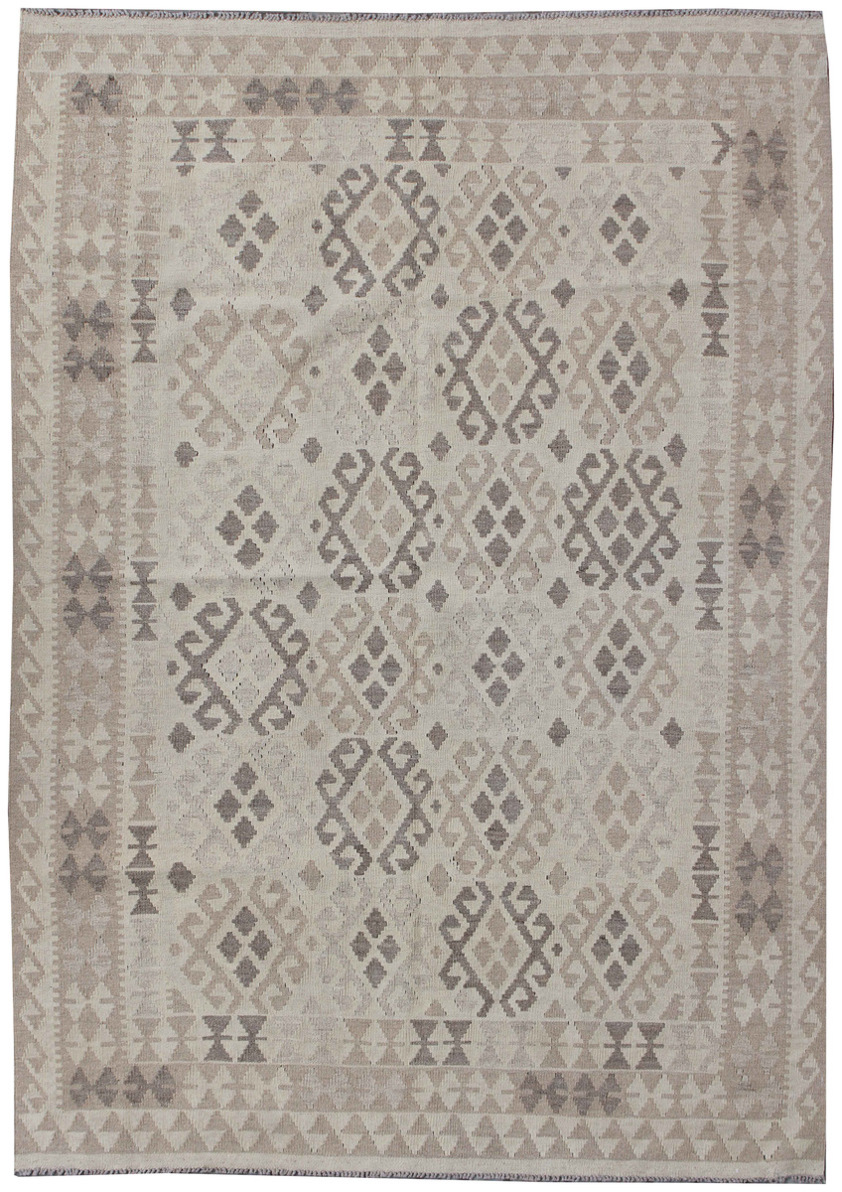
Large hooked medallions are scattered across the pale field of this rug, their taupe outlines enclosing open centres. Small groups of darker diamonds occupy the spaces between them, giving the lighter drawing a few firmer accents. The border is composed of several close geometric bands, with little angular marks repeating around the rectangle. The arrangement feels ordered without forming a strict central axis. At 250 × 176 cm, this rug would work well beside a sofa or beneath a compact coffee table. Cream seating and pale wood would preserve the gentle palette, while a dark timber piece could answer the diamond groups.
The open interiors of the larger motifs leave enough light ground visible for the design to remain airy. The wider kilim tradition has long served domestic interiors across Afghanistan and adjacent regions. Rugs and other household weavings use related angular forms, adjusting their spacing and scale to suit different formats. This example gives the hooked figure an independent role, rather than linking every outline into one continuous lattice.
The smaller diamonds provide an important counterpoint. Their compact shapes change the pace between the broad medallions, and the fine border reduces the scale again at the edge. Subtle horizontal tonal variations add texture to the pale ground. An uncluttered setting would allow those gradual changes of pattern and emphasis to remain visible around the furniture.