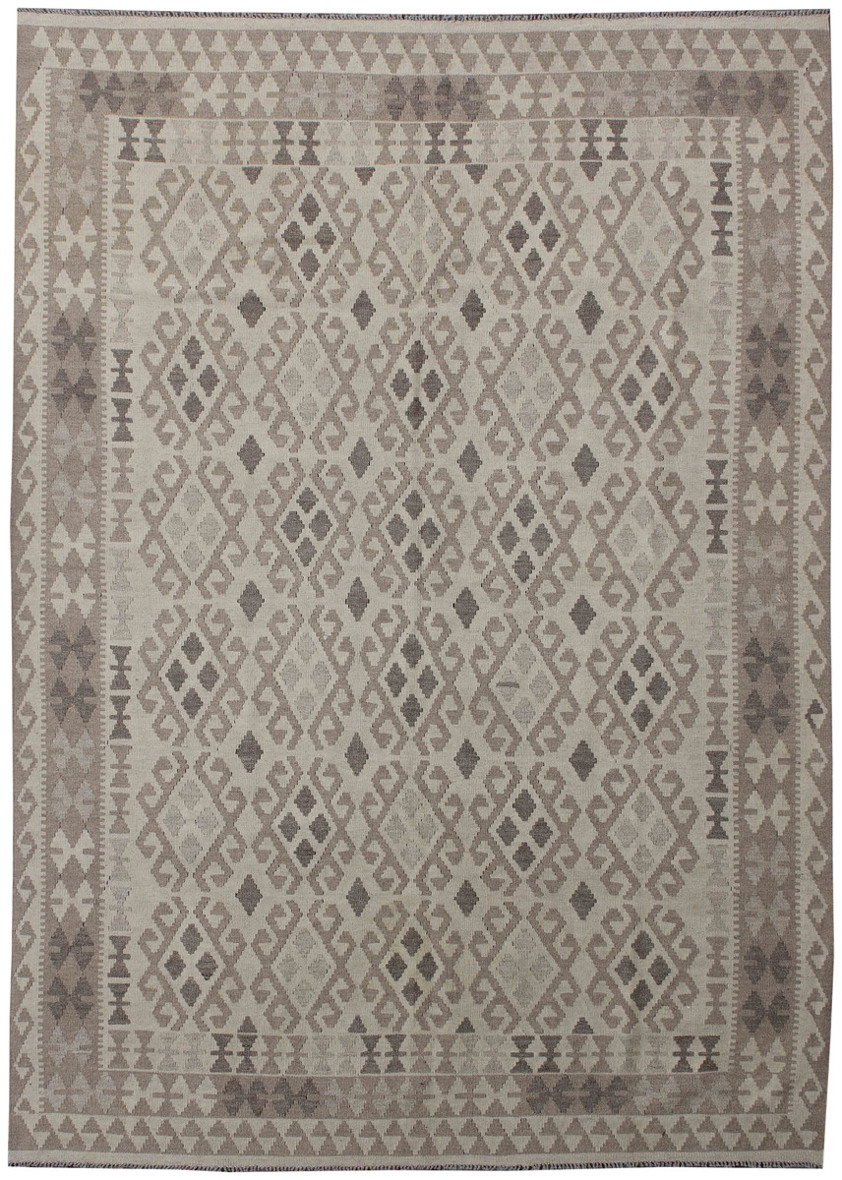
A dense network of hooked outlines covers the ivory field of this rug. Taupe and grey forms interlock in narrow vertical sequences, with occasional darker diamond clusters giving emphasis to individual points. The border is built from several bands of miniature geometric marks, each changing the rhythm slightly. The overall palette is quiet, but the surface is far from plain. At 290 × 206 cm, this rug would bring detailed pattern to a generous seating area. Its neutral colours could sit alongside cream upholstery, warm grey walls and dark or light timber.
The close repeat is particularly useful beneath a table: enough pattern remains visible around the furniture to preserve the design’s character without requiring a central medallion to be exposed. The kilim tradition has a long domestic history across Afghanistan and surrounding regions. Floor coverings, bags and other furnishings share an angular ornamental language, although their arrangements vary widely. This example concentrates that vocabulary into a continuous field, making repetition itself the principal decorative device.
Look closely and the darker groups become more apparent among the paler hooks. Fine tonal variation also gives depth to the ivory spaces between them. The layered frame provides a distinct boundary around this intricate middle, with little triangles and lozenges reducing the scale towards the edge. In a room with broad, uncomplicated furniture, those narrow patterned bands would supply an especially effective change of texture and detail.