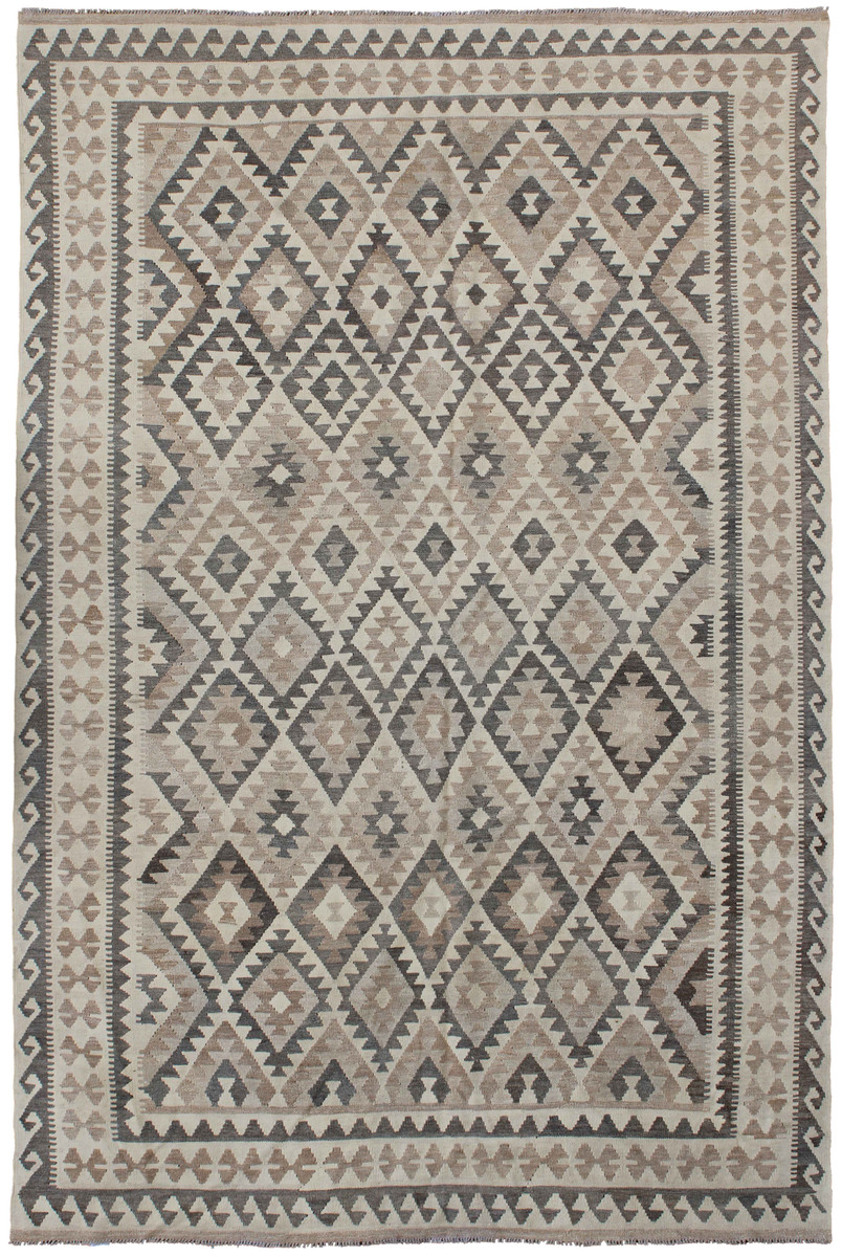
Charcoal outlines give this rug a particularly clear geometric pattern. Rows of stepped diamonds enclose smaller pale centres, while grey and taupe forms fill the intervals. The ivory ground separates each unit, and several narrow bands around the perimeter repeat miniature angular motifs. A darker outer line brings the complete rectangle into focus. At 302 × 201 cm, this traditional Afghan kilim could anchor a generous seating area in a predominantly neutral room. Charcoal upholstery or black metal would answer the strongest outlines; warm wood would pick up the softer taupe notes.
The all over repeat makes it easy to place a central table without concealing the only point of interest. The border would retain a distinct presence around the furniture. The broader kilim tradition has long furnished homes across Afghanistan and neighbouring regions. Its geometric vocabulary is highly adaptable, with diamonds able to form chains, centres or continuous fields.
In this rug they are arranged throughout the interior, making the relationship between light ground and dark edge more significant than any single medallion. The interiors of the diamonds are deliberately quieter than their outlines, allowing different shades of grey to add depth within a limited palette. Fine tonal grain is visible between the larger forms. In a room with plain surfaces, this detailed repeat would provide a measured contrast while keeping the overall colour scheme closely controlled.