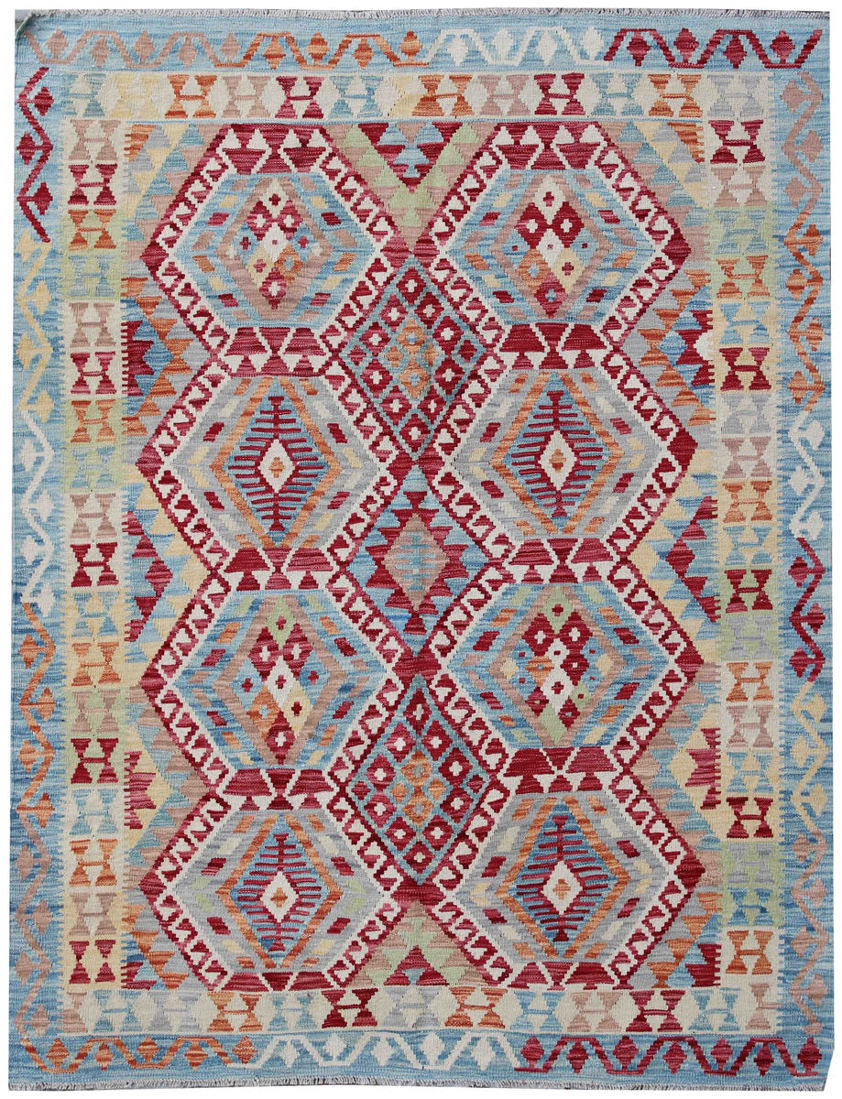
Four paired rows of hexagons create a substantial central pattern on this rug. Their red hooked outlines enclose pale blue interiors, with diamond clusters alternating with more finely banded centres. Small red and blue lozenges occupy the spaces between the pairs. A broad pale blue border contains repeated angular motifs in cream, burgundy and ochre, extending the colour scheme while changing the scale. The design has the clear field and border organisation often associated with traditional rugs, but its changing interiors prevent the repeated hexagons from feeling uniform.
At 227 × 173 cm, this Afghan kilim would be a useful anchor for a modest seating arrangement. Cream upholstery could echo the light outlines, while pale blue walls would connect with the border. A low table placed off the central axis would leave more of the paired pattern on view. Kilim furnishings belong to the geometric textile traditions of Afghanistan and its surrounding regions.
Lozenge and hexagonal units can be repeated, linked or nested, allowing a familiar group of forms to support considerable visual variety. Here the red outlines provide the strongest continuity, while the finer detail changes within them. The slight tonal variation through the blue gives this rug an appealingly textured appearance at close range. It would bring a distinct pattern to a room without requiring a broad mixture of unrelated colours in the surrounding furnishings.