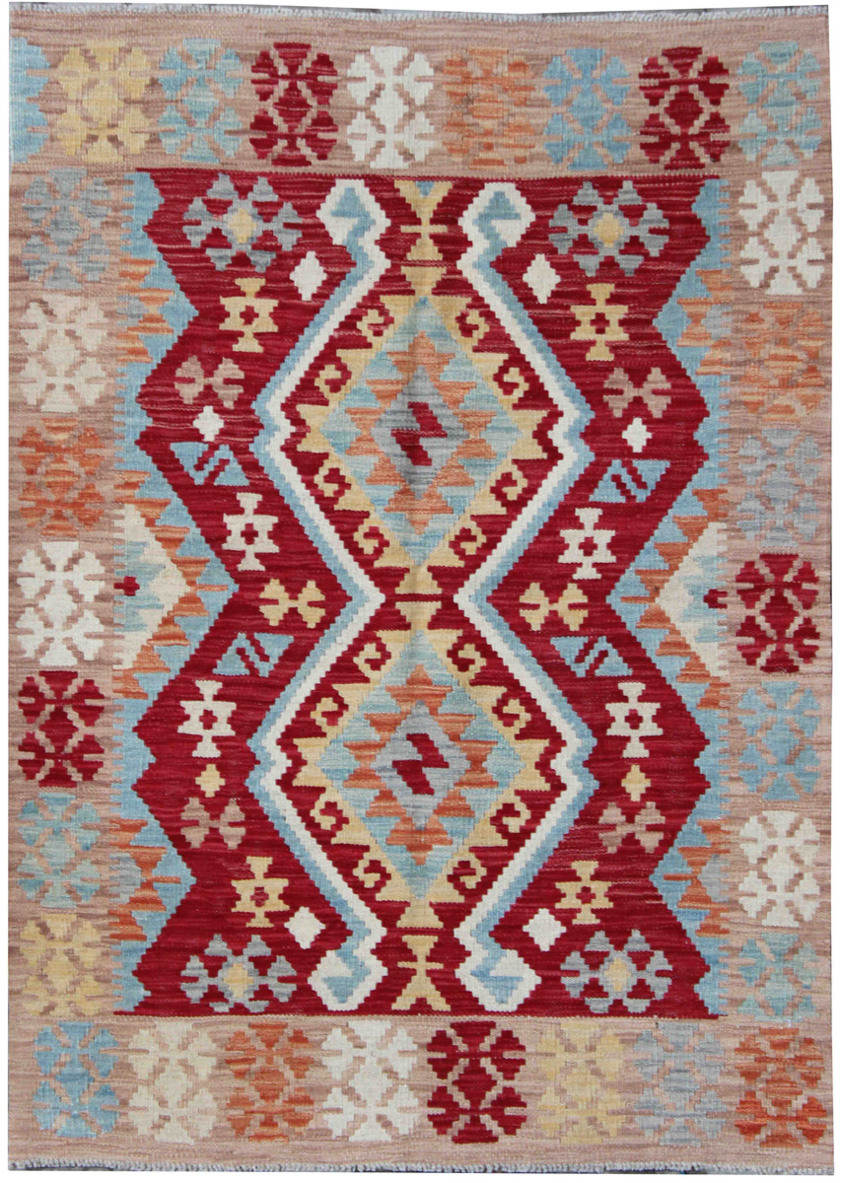
Two pale blue diamonds draw the eye through a burgundy central panel on this rug. Their stepped edges are bordered in cream, with small rust and blue forms nested inside. The panel’s sides widen and narrow around the diamonds, producing a pronounced zigzag silhouette. A broad, lighter surround contains rows of small geometric motifs in blue, peach, cream and muted yellow. The balance between the deep red centre and the pale border gives this traditional Afghan kilim a strong sense of proportion.
It measures 146 × 103 cm, so it can add a complete decorative statement to a relatively small area. Beside a reading chair, the pale frame would remain visible around the furniture; in a bedroom, its blue and cream details could be repeated in plain linens. The warm red would also bring contrast to a floor in a cool grey tone.
Kilim designs form part of an extensive household textile tradition across Afghanistan and adjacent regions. Angular outlines and repeated lozenges provide a vocabulary that works at many scales, and compact examples often retain the same field and border distinctions as larger rugs. This rug demonstrates that clarity well. The paired diamonds establish an uncomplicated structure, while the little surrounding marks add variety. At close quarters, fine colour changes within the forms introduce a softer visual texture beneath the decisive geometry.