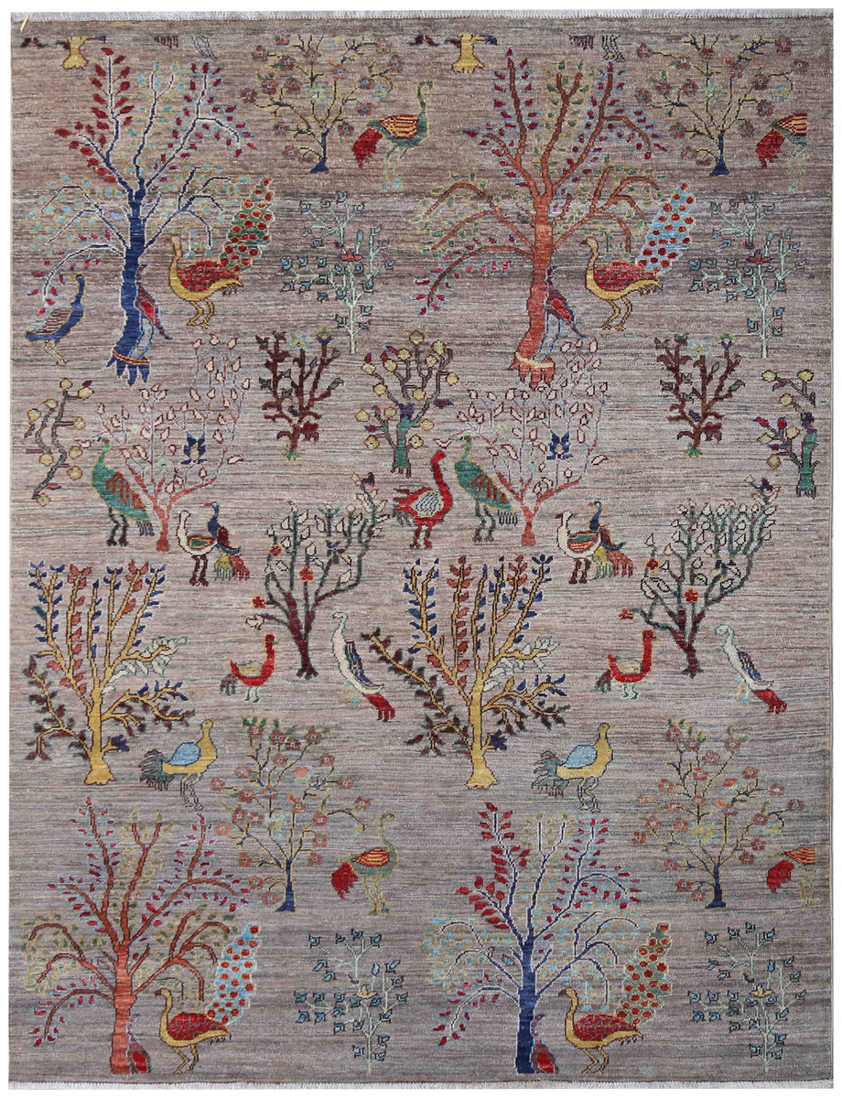
Colourful birds and branching trees spread across the grey field of this contemporary Afghan rug. Red, blue, green, yellow and warm neutral details distinguish the birds' bodies and long patterned tails. Slender trunks support varied branches, with smaller plants and compact flower-like units appearing between the larger subjects. The figures face in different directions, giving the whole scene movement without requiring a single dominant central motif. Grey remains visible around each group, making the pictorial silhouettes easy to separate. Some trees are lightly drawn, while others have stronger blue or red trunks.
The birds also change in scale and pose, so different parts of the field offer their own small arrangements rather than an identical repeated scene. Afghanistan's textile traditions include a wide range of geometric, floral and pictorial floor-covering designs. Figurative subjects can organise a field through spacing and direction instead of a formal medallion-and-border structure. That broader decorative context is relevant here, while the photograph does not establish a named weaving community or particular motif symbolism.
The individual birds, plants and open grey intervals supply the rug's visible identity without requiring those additional attributions. Plain cream seating or light wood would leave the different figures readable. A blue ceramic could relate to the stronger tree trunks, while a muted red textile would echo warmer birds. An uncovered placement would preserve the changing groups across the surface. Quiet surrounding fabrics would allow the smaller leaves and floral units to remain visible nearby.