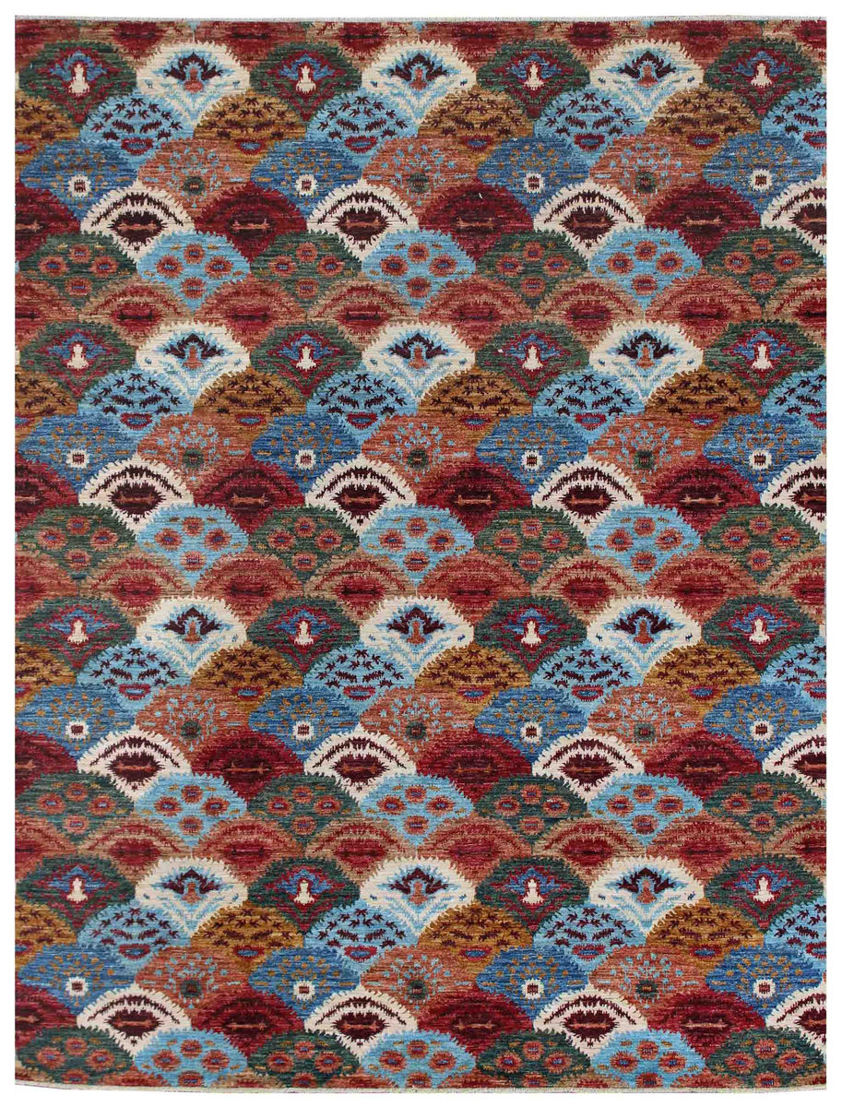
Overlapping scalloped forms cover this rug in closely packed rows. Blue, red, ochre, green and ivory alternate across the field, with each fan-like shape containing smaller floral marks. Some have pale serrated edges, others a dark outline or a cluster of round blossoms. The repeat continues to the sides without a separate border. The pattern has two distinct readings. From farther away, the scallops form a rolling, almost wave-like arrangement of colour. At close range, their internal details become clearer: small rosettes, pointed leaves and compact contrasting dots.
Red and blue provide the strongest accents, while ochre and muted green ease the transitions between them. Afghanistan's weaving culture sits within a region where botanical ornament and repeated geometric arrangements have long interacted. Contemporary Afghan rugs can draw on that extensive decorative vocabulary without reproducing a single historical regional pattern. Here, the scalloped outline acts as an organising unit, bringing varied flowers and colours into a continuous arrangement across the whole surface.
Measuring 298 × 200 cm, this rug could provide a richly patterned base for a living room or study. A plain sofa would leave its layered drawing easy to appreciate, and a table with slender legs would allow more of the repeat to remain visible. Picking up one of the quieter greens or ochres elsewhere could connect the room without increasing its visual intensity. The absence of a medallion also allows flexible placement around an existing furniture arrangement.