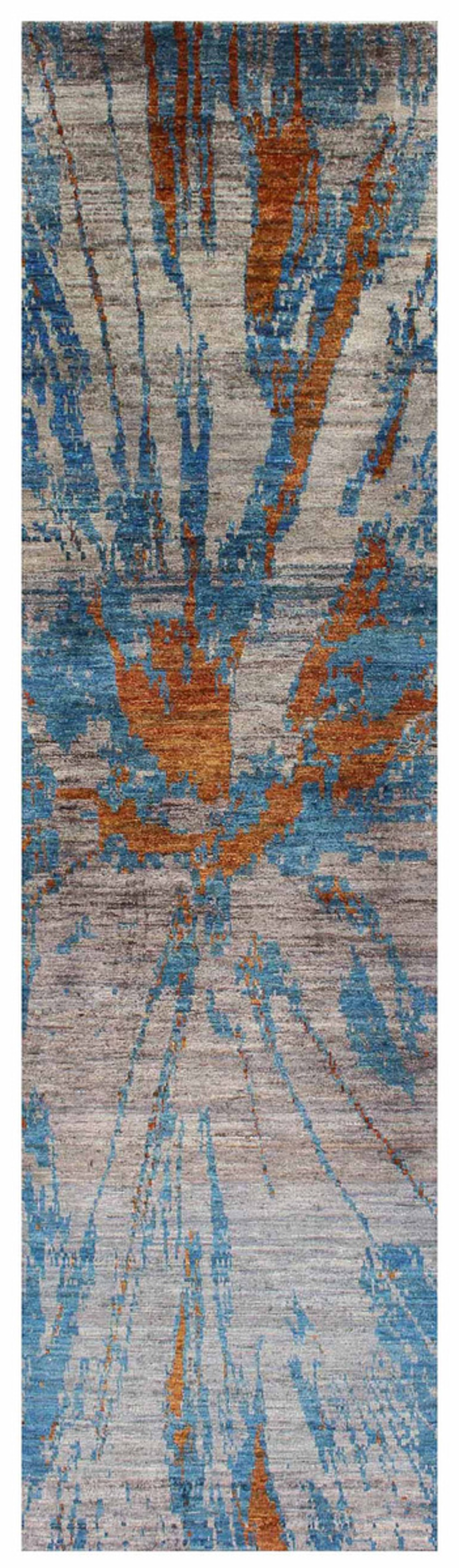
Blue and rust-coloured marks spread through the pale grey ground of this runner. Some rise in long, narrow streaks; others gather into broader, broken patches near the middle. Fine horizontal variations cross the surface, interrupting the stronger vertical movement. The design has no separate border, so the abstract forms continue towards the edges rather than sitting within an ornamental frame. The long format gives the marks a distinct sense of movement. A larger rust shape below the centre is answered by smaller warm accents above, while blue carries the eye through most of the length.
Pale grey intervals remain important, separating the stronger passages and preventing the surface from becoming a continuous dark band. Afghanistan's carpet traditions have developed within a region connected to several major textile cultures. Alongside inherited geometric and floral patterns, contemporary Afghan rugs explore more abstract arrangements of colour and line. This part silk runner follows that direction, allowing an irregular, almost painterly composition to take the place of repeated medallions or a conventional scrolling border.
Measuring 290 × 76 cm, this runner would bring a focused strip of colour to a hallway or an open bedside area. Warm timber would relate to the rust, while blue-grey walls could draw out the cooler marks. Simple surrounding finishes would leave the shifting shapes easy to follow. Its interest lies in the changing relationship between pale space and concentrated colour along the full length.