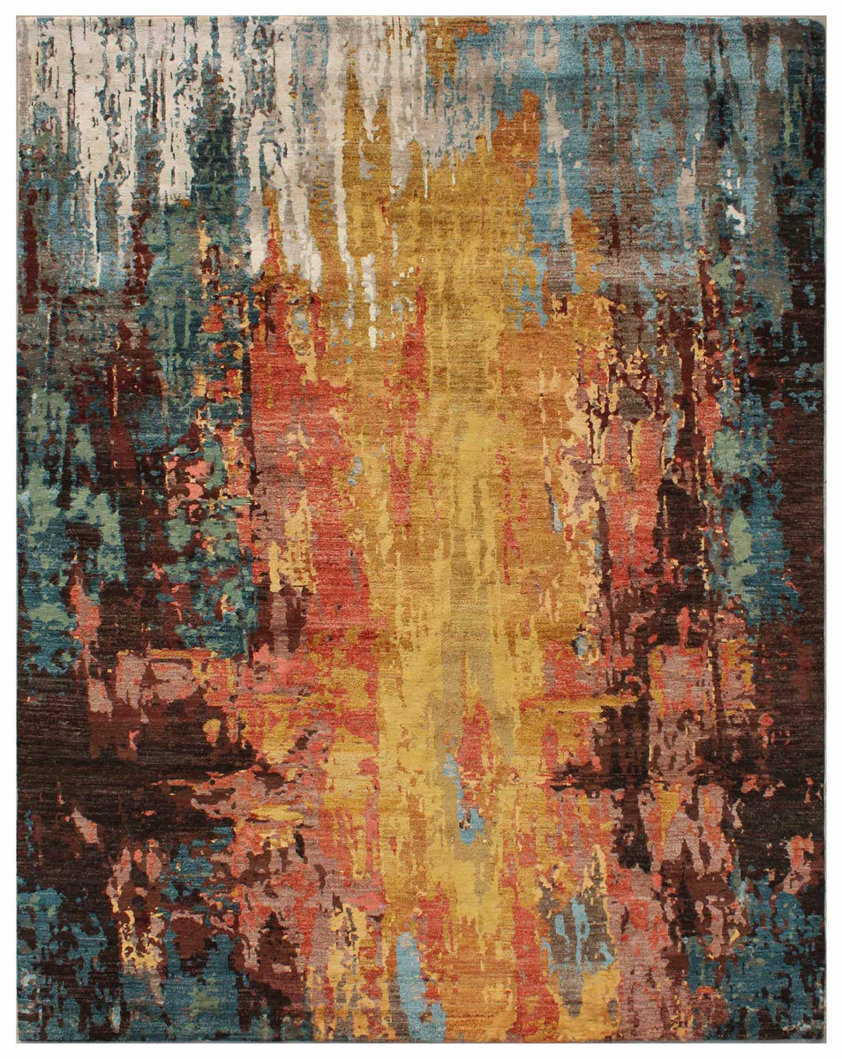
A golden centre opens through teal, rust and dark brown in this rug, giving the abstract field a strong area of warmth. Pale marks descend from the upper edge, while darker fragments gather towards the sides and lower area. The drawing changes direction as colours meet, producing a layered composition rather than a regular stripe. This part silk Afghan transitional rug gives the broad golden passage an organising role. Around it, smaller red, blue-green and brown marks create a finer texture of pattern. Some forms are large enough to read across the room, while their edges resolve into many little interruptions nearby.
The different scales remain connected through the repeated warm and cool colours. The 240 by 300 centimetre format would suit a generous seating group. Plain upholstery could give the centre space to register, while dark wood would relate to the deeper brown. Muted teal or rust in a smaller fabric could acknowledge another part of the palette without reproducing its complexity elsewhere.
Contemporary Afghan rug design includes such abstract fields alongside more formal interpretations of traditional ornament. Here colour and density establish the structure, with no central floral medallion or broad patterned border. This rug would be particularly effective where part of the middle stays uncovered, allowing the golden opening and its surrounding darker fragments to remain visible together. Its appeal rests on that balance between a clear overall colour movement and finely broken details within it.