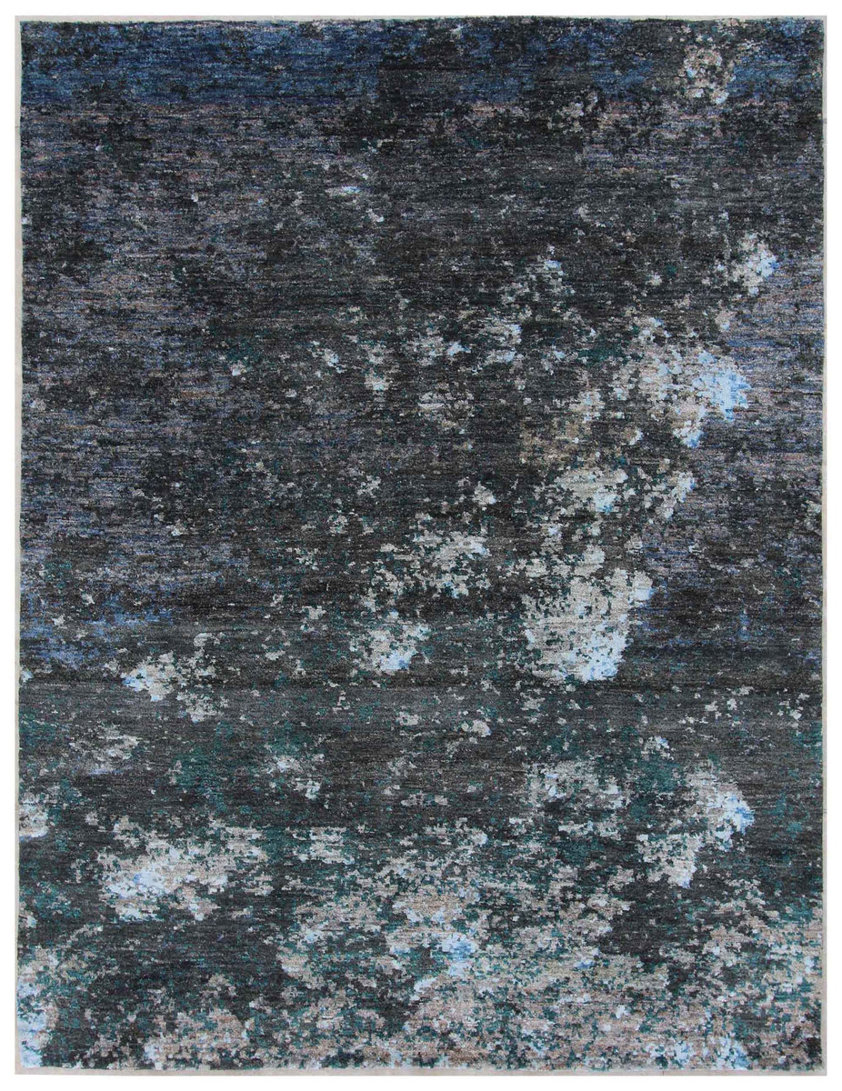
Pale blue and ivory fragments interrupt a deep blue-charcoal field in this rug. The lighter drawing gathers into irregular clusters, becoming more prominent towards the lower area while leaving darker passages above. Fine horizontal marks connect those sections, giving the surface a direction without forming a regular series of stripes. This rug would bring depth to a room with light upholstery or pale wood. Its 183 by 239 centimetre dimensions provide enough surface for the abstract pattern to remain visible around a small table.
Cream fabric could pick up the palest fragments, while a dark bookcase or desk would relate to the ground. Warm white walls would keep the cool palette from feeling too enclosed. In this part silk Afghan rug, the different concentrations of detail provide the basis for its abstract arrangement. Larger dark areas provide intervals between the smaller pale marks, allowing the field to remain coherent without a central medallion or continuous botanical repeat. The arrangement belongs to the more abstract strand of contemporary Afghan design.
Close inspection reveals how the boundaries dissolve into many short lines. Some pale details stand alone, while others merge into broader blue-grey passages. From a distance, this rug reads mainly as a dark surface with light movement. Nearby, the little variations in spacing and tone become more important, giving the relatively limited palette a finer complexity throughout the field.