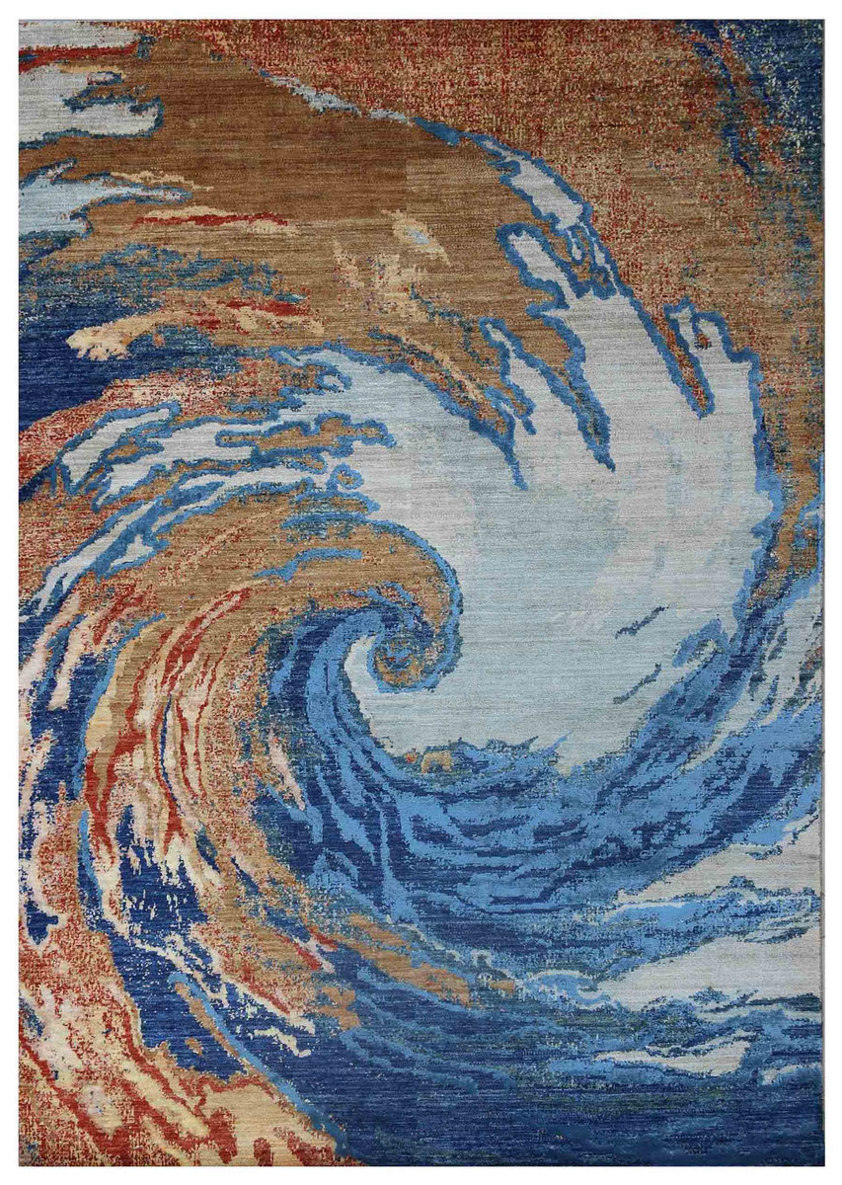
Sweeping blue and ivory forms curl through this rug, meeting broad passages of gold and warmer rust. Darker blue outlines sharpen several curves, while finer marks break their edges and connect neighbouring colours. The movement is strongly directional, suggesting a wave-like sweep without resolving into a literal scene. This rug would be particularly effective where much of the centre can remain visible. Its 180 by 271 centimetre proportions could define a long seating arrangement, with an open-based table preserving the main curve.
Plain upholstery would give the drawing space, while warm wood could relate to the golden and rust-coloured areas. In this part silk Afghan transitional rug, abstract movement replaces the regular repetition of a conventional floral field. Colour and curve supply the structure, allowing larger open forms to coexist with finely fragmented detail. The composition has a clear sense of direction, yet its smaller marks remain varied enough to reward close inspection. The strongest contrast occurs where ivory opens between deeper blues.
Elsewhere, gold and rust give the curved forms warmth, preventing the field from becoming entirely cool in tone. Seen from a distance, this rug makes its effect through broad sweeping shapes. Nearby, the outlines resolve into many short lines and small colour changes. Its individual character lies in that relationship between an expansive movement across the floor and the more intricate drawing within each coloured passage, particularly around the turning point of the central curve.