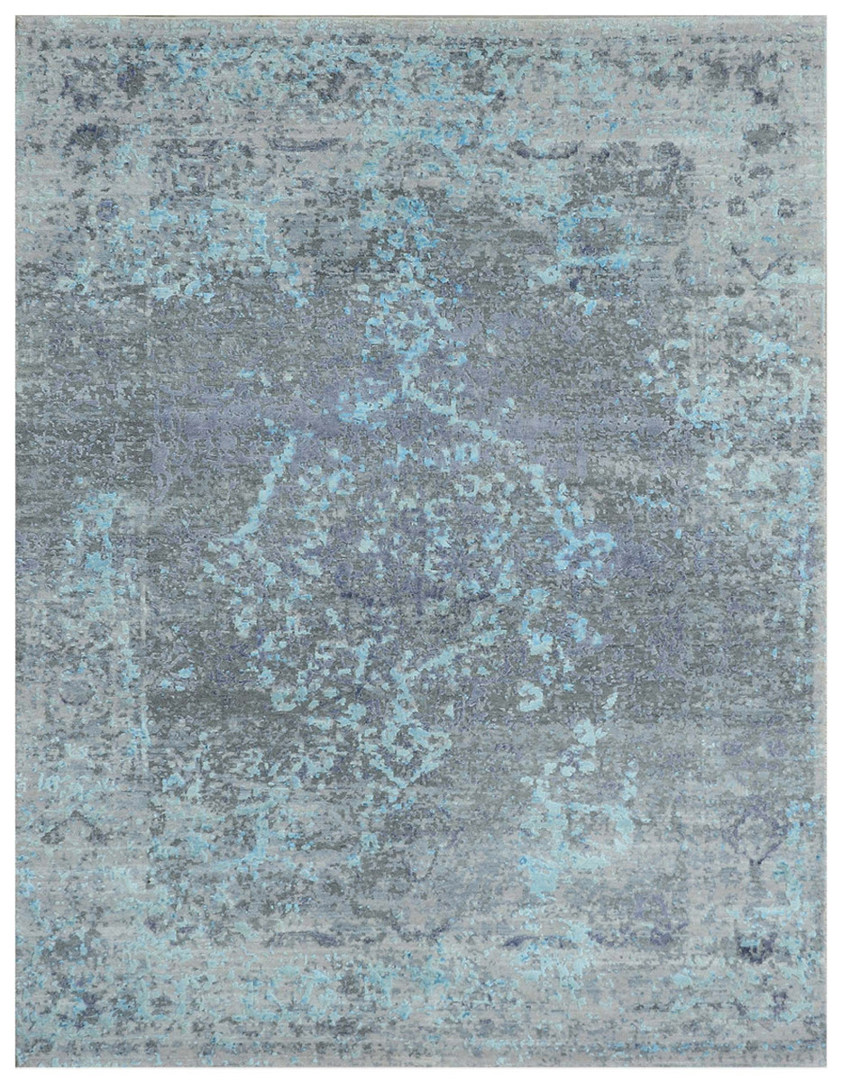
Pale blue and grey give this rug a light, closely coloured field. Ornamental traces gather more densely in some areas, while others soften into broad passages of near-plain colour. A faint enclosing framework remains apparent around the edge, providing structure without creating a strong dark border. This rug would be useful in a room that needs pattern without a pronounced contrast. Its 170 by 240 centimetre format could define a compact seating area or occupy the open floor of a bedroom. Warm white fabric would relate to the palest details, while darker timber could give the blue-grey greater definition.
A little soft blue elsewhere would be enough to establish a connection. In this part silk Afghan transitional rug, familiar ornamental forms are presented through fragmented drawing and muted colour. The composition retains suggestions of a traditional field and surround, but the varying clarity of the pattern changes how those elements are read. Some details can be followed closely; others become tonal movement within the larger pale surface.
The most interesting passages occur where a denser grey shape meets a lighter blue area. Their boundaries are finely broken, giving the field a layered appearance without requiring several strong colours. This rug is best appreciated at a range of distances: from further away, it provides a quiet foundation; nearby, the small ornamental interruptions become clearer. Its individuality rests on that gentle shift between an open pale impression and more elusive detail within the field.