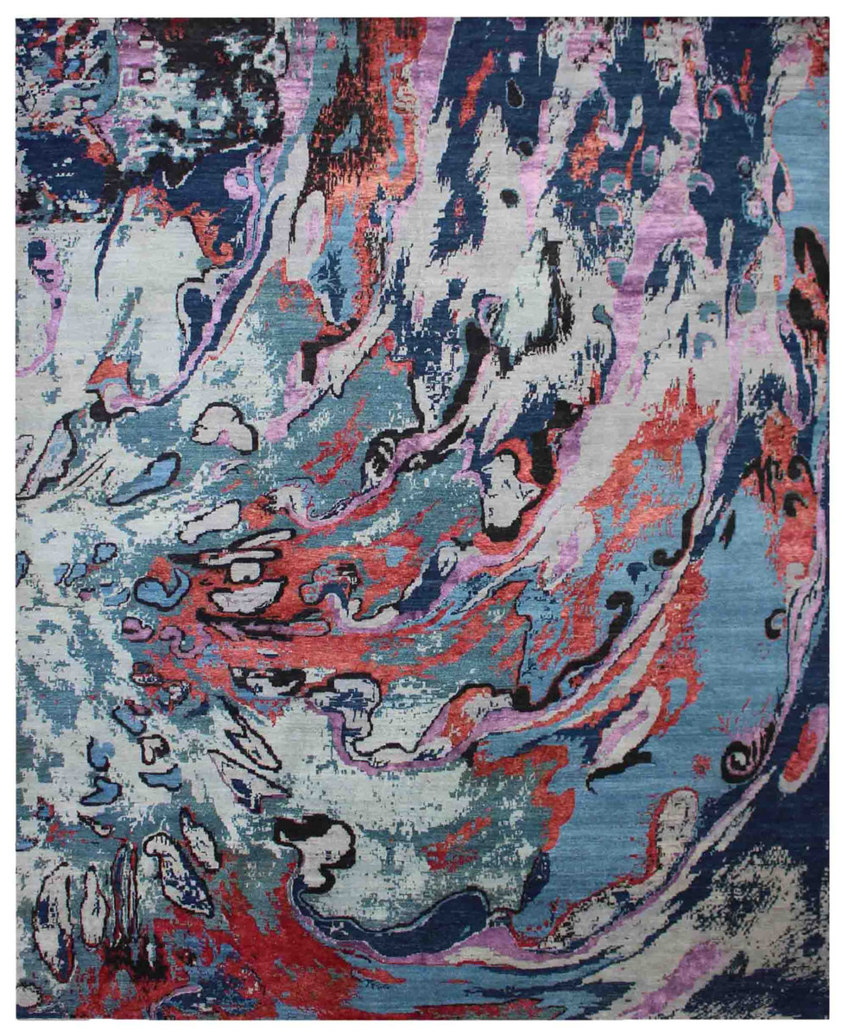
Blue, coral and lilac sweep across this rug in broad, irregular forms. Dark navy curves give several passages a clear outline, while cream and pale green-grey open up the surrounding areas. The drawing changes direction repeatedly, creating a fluid composition in which no single shape governs the whole field. The exceptional 357 by 439 centimetre dimensions give those movements considerable scale. This rug would need a generous room, where a substantial seating arrangement could leave different coloured passages exposed.
Plain upholstery would allow the curves to remain the principal pattern. Dark timber could relate to the navy, while warm white walls would keep the lighter colours clear. In this part silk Afghan transitional rug, colour and direction replace the familiar order of a central medallion enclosed by borders. The design moves between broad open forms and closely fragmented detail, allowing several rhythms to coexist across one rectangle. It is an example of the more abstract strand of contemporary Afghan rug design.
Seen from a distance, the main impression is of sweeping colour. Closer by, many of the boundaries break into short marks and little interruptions, giving the field a finer complexity. Pale areas are especially effective beside the dark curves, while coral accents draw the eye through the blue. This rug would reward a setting with more than one viewpoint, revealing different connections between the coloured passages as one moves around the room.