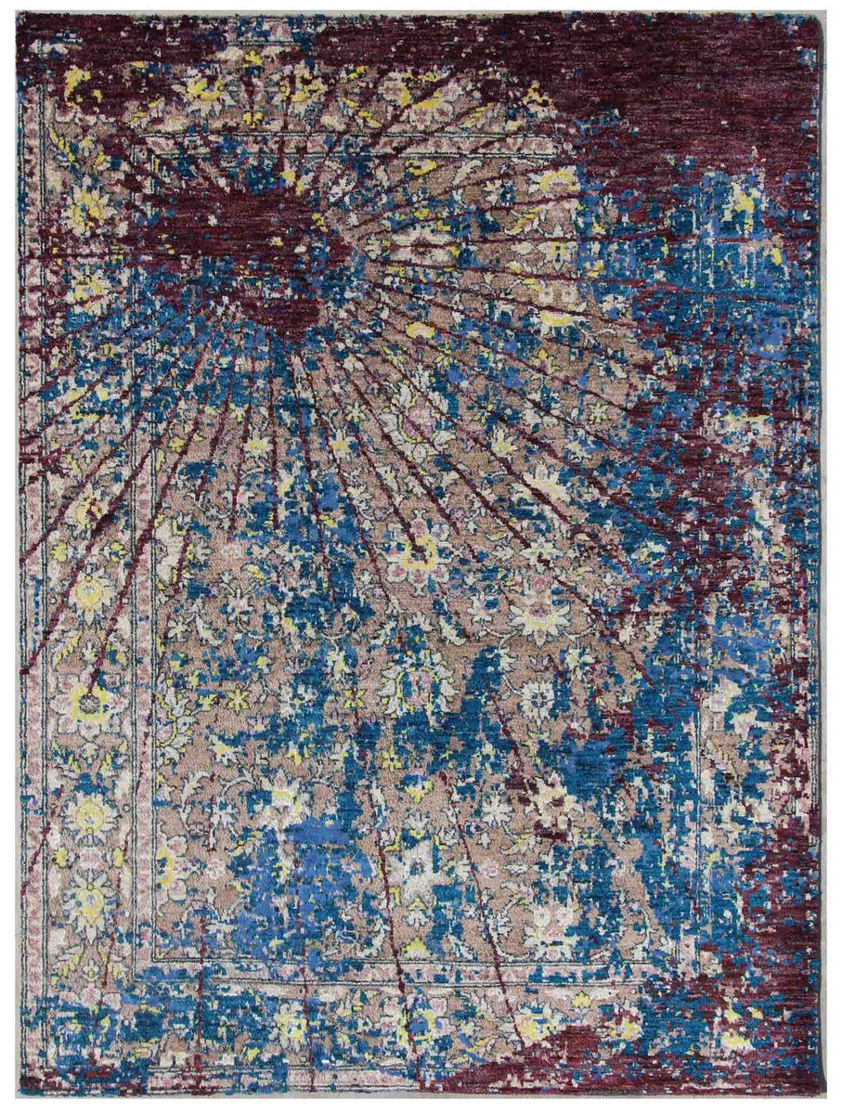
Fine lines radiate from a dark, off-centre form in this rug, spreading through cream, blue and muted gold passages. The arrangement suggests a broad fan of drawing across the upper area, then breaks into smaller abstract fragments below. Deep burgundy-brown gives the edges weight, while brighter blue interrupts several of the lighter sections. This part silk Afghan transitional rug has a more directional composition than a uniformly repeated field. The radiating lines lead the eye from one area into another, connecting broad coloured shapes with finer broken marks.
There is no conventional medallion-and-border framework. Instead, the contrast between the dark focal area and the lighter surrounding detail supplies the principal structure. At 184 by 243 centimetres, this rug could provide a distinct patterned centre for a modest living room. A low table with an open base would keep the radiating drawing visible, while a plain sofa would allow the many small colour changes to remain clear.
Cream fabric could relate to the pale passages; dark wood would connect with the deeper brown. The lower field rewards a closer look, where the blue and pale fragments become more intricately interspersed. Some details are nearly floral in outline, but they do not resolve into a continuous botanical repeat. This rug's character lies in that changing legibility, moving from a recognisable fan-like arrangement to a finer collection of marks as the eye travels across its surface.