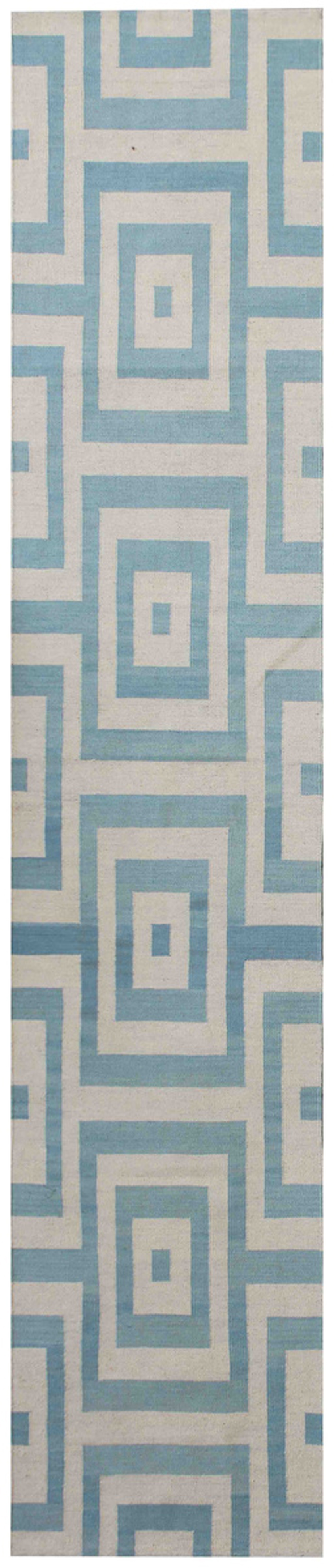
Pale blue paths turn through repeated right angles on the cream field of this rug. Nested rectangles form a lengthwise sequence, with short connecting sections carrying the lines towards the narrow sides. Some outlines continue beyond the edge, while others close around a small central block. The palette remains simple, giving the changing line paths a clear graphic presence. The rug's elongated 347 × 69 cm shape would be useful along a hallway, beside bookcases or across a narrow landing. Its pale colours would keep the floor light, and the squared geometry could relate comfortably to painted joinery or cabinet doors.
Blue details elsewhere need only be small to establish a connection with the field. Geometric organisation is fundamental to many Afghan kilims. Within that flatwoven tradition, the same basic straight-sided forms can be altered through changes of direction, scale and spacing. This contemporary rug concentrates on the rectangle, allowing nested outlines and open turns to provide movement without introducing numerous separate motifs.
The blue is broad enough to register at a distance, while the cream intervals prevent the paths from becoming a continuous dark mass. Small variations along the edges soften the precision of the right angles. A margin of plain floor would make the long outline clearer, particularly where the pattern reaches the sides. The absence of a single central emblem gives freedom to position the rug according to the route through the room.