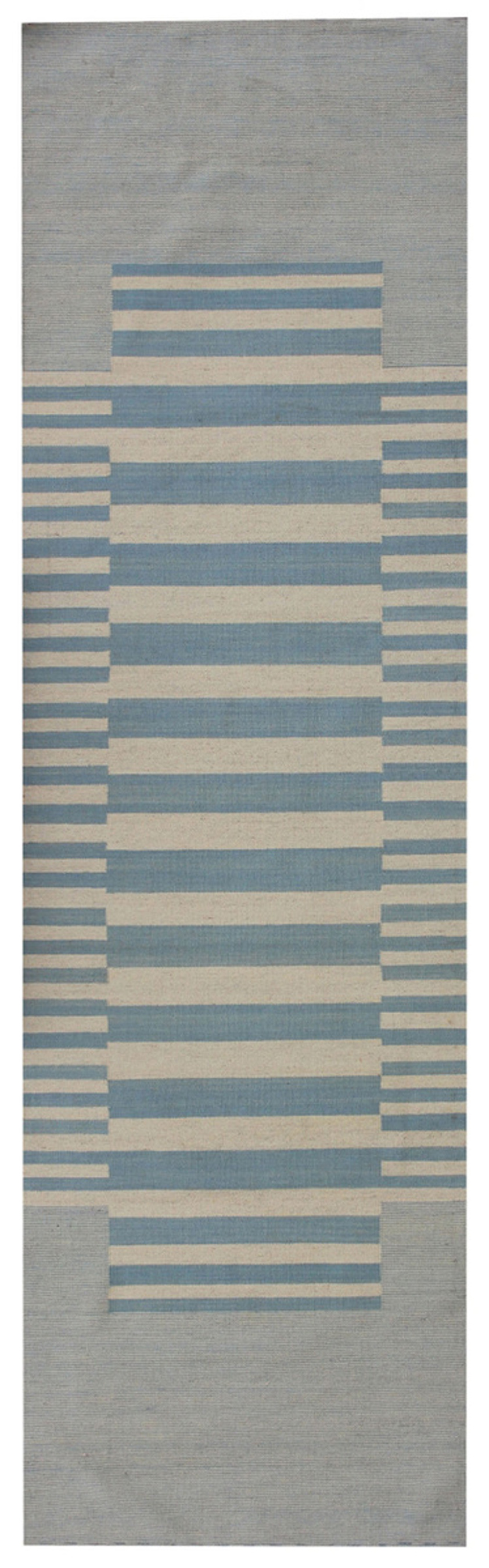
A stepped panel of blue and cream stripes occupies the centre of this runner. The bands widen and narrow as they move along its length, with short striped extensions reaching towards the sides. Broad grey areas at either end give the central arrangement space, creating a measured balance between pattern and open ground. This rug has a narrow 79 by 287 centimetre format that gives the stepped panel a clear sense of direction. It would sit well along a passage or beside a long piece of furniture, where the stepped shape could be viewed lengthways.
Pale oak and warm white walls would relate to the cream bands, while blue-grey upholstery could connect with the cooler drawing. Flatweaving has a long place in the textile traditions of Afghanistan and surrounding regions. Kilims use the relationship between coloured areas and geometric divisions to create pattern without relying on a piled surface. This contemporary Afghan kilim rug makes that relationship particularly clear, limiting its vocabulary to horizontal bands, stepped edges and a restrained grey surround.
The central stripes are not simply repeated at one width. Their changing reach gives the composition a quiet sense of expansion and contraction, while the plain ends prevent it from becoming crowded. This rug would be especially appealing in a space that needs some geometry but already contains detailed joinery or artwork. Its individual character lies in the precise balance between those open grey passages and the compact striped centre.