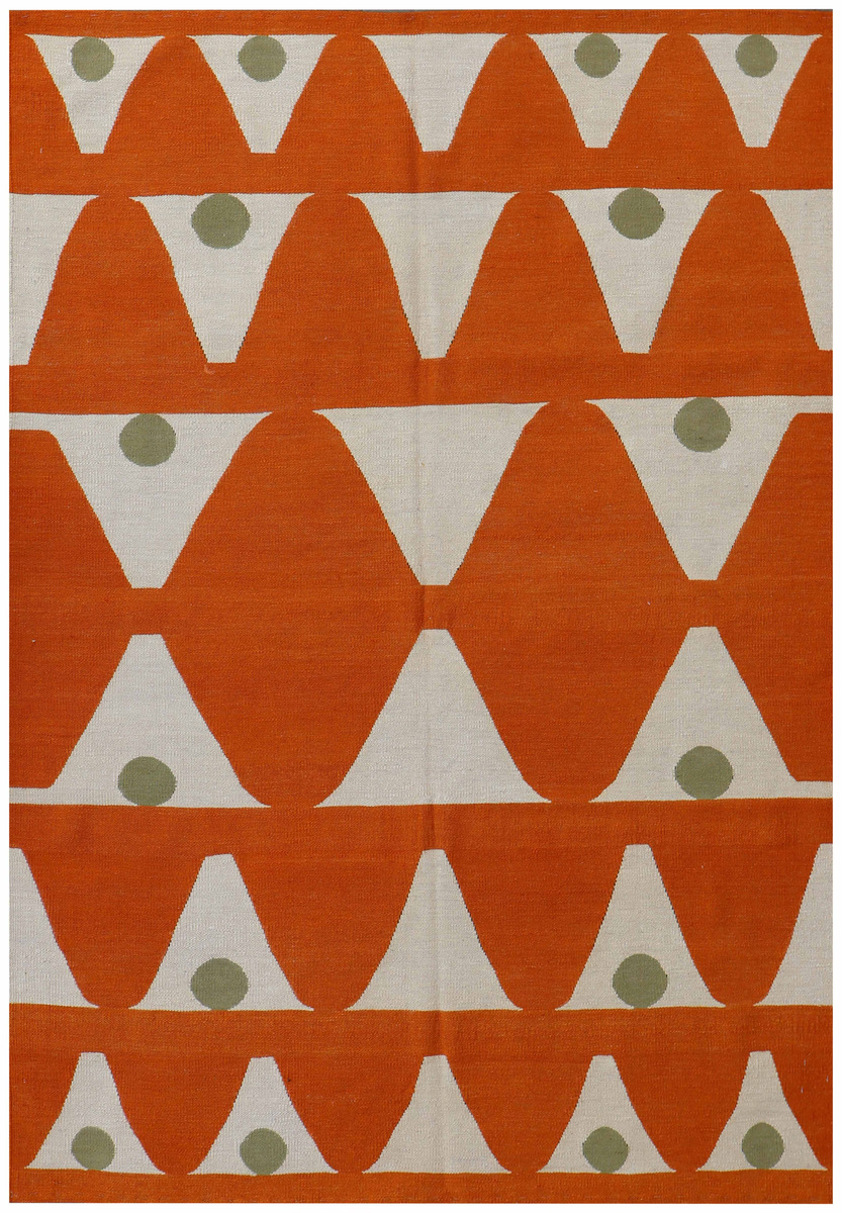
Large orange waves give this contemporary Afghan kilim rug a broad, graphic presence. Cream spaces taper into points between them, each holding a small olive circle. Horizontal bands divide the design, but the curves change in width and depth as they move down the field. The largest forms occupy the middle, with tighter repeats towards the ends. The palette is concentrated and easy to read from a distance.
Orange supplies the warm background and the curving forms, while cream creates open intervals within it. Olive dots add a smaller, quieter detail. Fine horizontal tonal differences remain apparent in the broad colour areas, giving the flat surface a woven depth that becomes clearer at close range. The design demonstrates the range available within kilim flatweaving. Coloured wefts interlace through the warp to create the textile and its pattern together, without knotted pile. Broad contrasting areas can be used as effectively as intricate stepped motifs. Here, a contemporary Afghan composition relies on proportion and repetition, with the relationship between curved orange shapes and pointed cream spaces taking the place of a conventional central medallion.
This rug could define an open seating area with simple cream upholstery and natural timber furniture. A table with a light visual footprint would keep the larger central waves visible. Olive accessories could relate to the small circles without adding another strong colour. Plain walls would provide room for the changing scale of the pattern to remain the principal decorative feature.