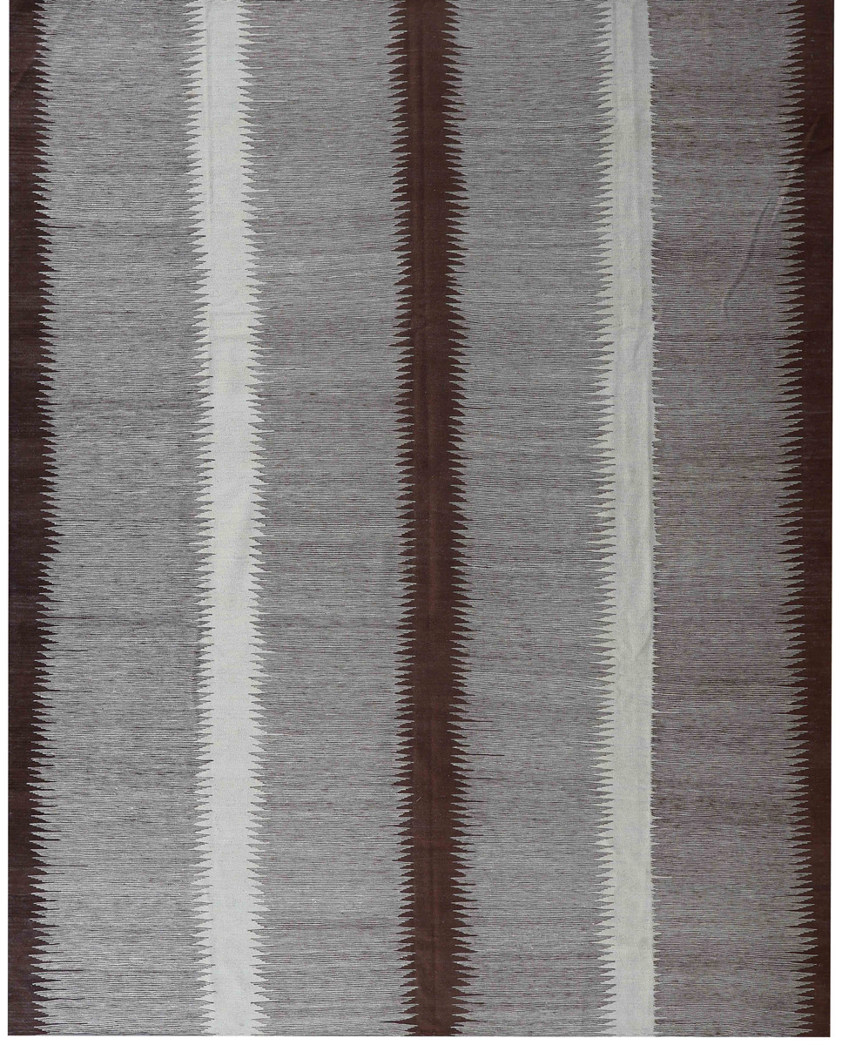
Feathered stripes extend across the length of this generously proportioned Afghan kilim rug. Brown, grey and cream form a restrained palette, with the darker bands narrowing and widening beside pale channels. Fine pointed edges give the transitions a serrated appearance. The pattern remains continuous from end to end, allowing line and tone to establish the composition rather than a single central motif.
At a distance, the bands create a clear architectural rhythm. Closer viewing reveals many small changes of shade and the fine teeth along each edge. Horizontal tonal variation adds depth within the flat surface, softening the stronger lengthwise divisions. The brown passages provide warmth, while grey and cream keep the overall effect balanced. A quiet perimeter leaves the broad stripe sequence as the main feature. In kilim weaving, coloured wefts interlace with warp threads to make a flat patterned textile. The structure differs from that of a carpet with knotted pile. It accommodates repeated angular transitions as well as more intricate geometric motifs. This Afghan example uses the method for a contemporary arrangement, giving a large furnishing surface interest through closely related neutral colours and carefully varied boundaries.
The rug would suit a substantial sitting room with simple furniture shapes. Plain upholstery would complement its reduced palette, and natural timber could echo the warmer bands. An open layout would preserve the long stripes and allow them to organise the floor area. Cream curtains or cushions would connect with the light channels, giving the room continuity without requiring identical patterns on other surfaces.