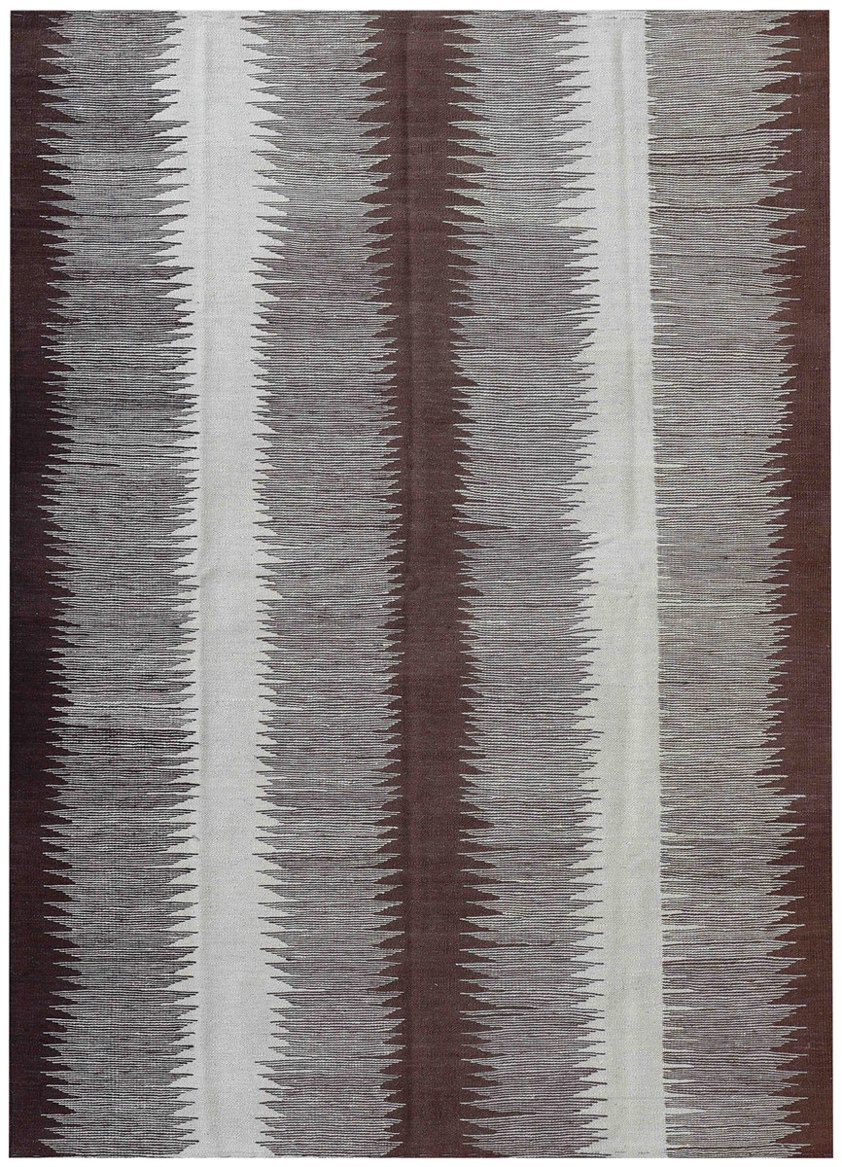
Fine grey and brown stripes run through the length of this contemporary Afghan kilim rug. Narrow cream channels separate the broader bands, while serrated edges create a feathered transition between neighbouring colours. The pattern is continuous, without a central medallion or broad contrasting border. Its interest lies in the spacing of the bands and the gradual shifts of tone within them. The palette is quiet but varied. Brown provides depth, grey softens the surface, and cream introduces light between the darker passages. Many tiny pointed edges give the stripes a gently animated appearance nearby.
Fine horizontal tonal changes add another layer of visual texture beneath the lengthwise design, preventing the broad bands from looking completely uniform. The kilim tradition is based on flatweaving, with coloured wefts interlacing with warp threads to form the textile. Its pattern is part of the woven structure rather than a knotted pile. The method supports both detailed geometric ornament and simplified contemporary arrangements. In this Afghan example, angular transitions are concentrated along the stripe edges, giving a reduced design a finely worked surface.
This rug would suit a room furnished with plain fabrics and natural materials. Cream upholstery could echo the lighter channels, while darker wood would connect with the brown bands. Its long lines could organise a seating area or add direction beside a bed. A simple table with open legs would preserve the stripe rhythm, allowing the quieter tonal differences to remain visible across the room.