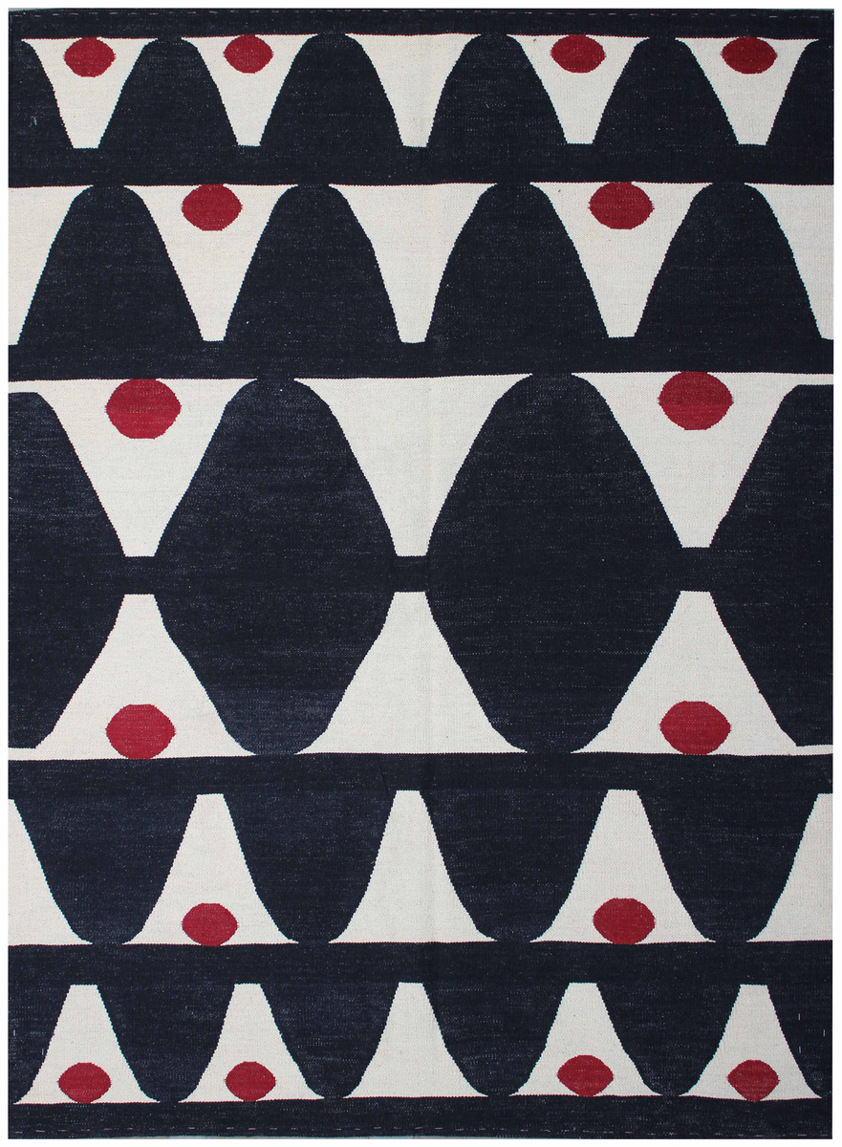
Black, white and red are used with striking economy in this contemporary Afghan kilim rug. Broad dark bands divide the surface into horizontal rows, while white tapered forms cut into their edges. Small red circles sit within selected pale shapes, adding a recurring accent that changes position as the composition progresses. The lowest row becomes smaller and more closely spaced. Seen together, these elements create a lively alternation of solid mass and open-looking space. Some white forms point downwards, others rise from below, so the pattern avoids a single repetitive direction.
The red dots are deliberately limited in number and scale; they act as punctuation rather than a second dominant colour. A dark outer edge brings the different rows into one clearly defined rectangle. Afghan kilims belong to a wider regional tradition in which geometric drawing is central to domestic textiles. Contemporary interpretations can retain that direct relationship between shape and surface while moving away from familiar stepped diamonds or hooked motifs.
This rug uses a much more graphic vocabulary, letting a few repeated forms provide the whole decorative argument. At 233 by 170 cm, it could give a sitting room or studio a confident focal point. Pale floors would sharpen the dark outline, while black furniture details could connect with the horizontal bands. A restrained red accessory would be sufficient to echo the circles, leaving the geometry itself to supply most of the room's visual energy.