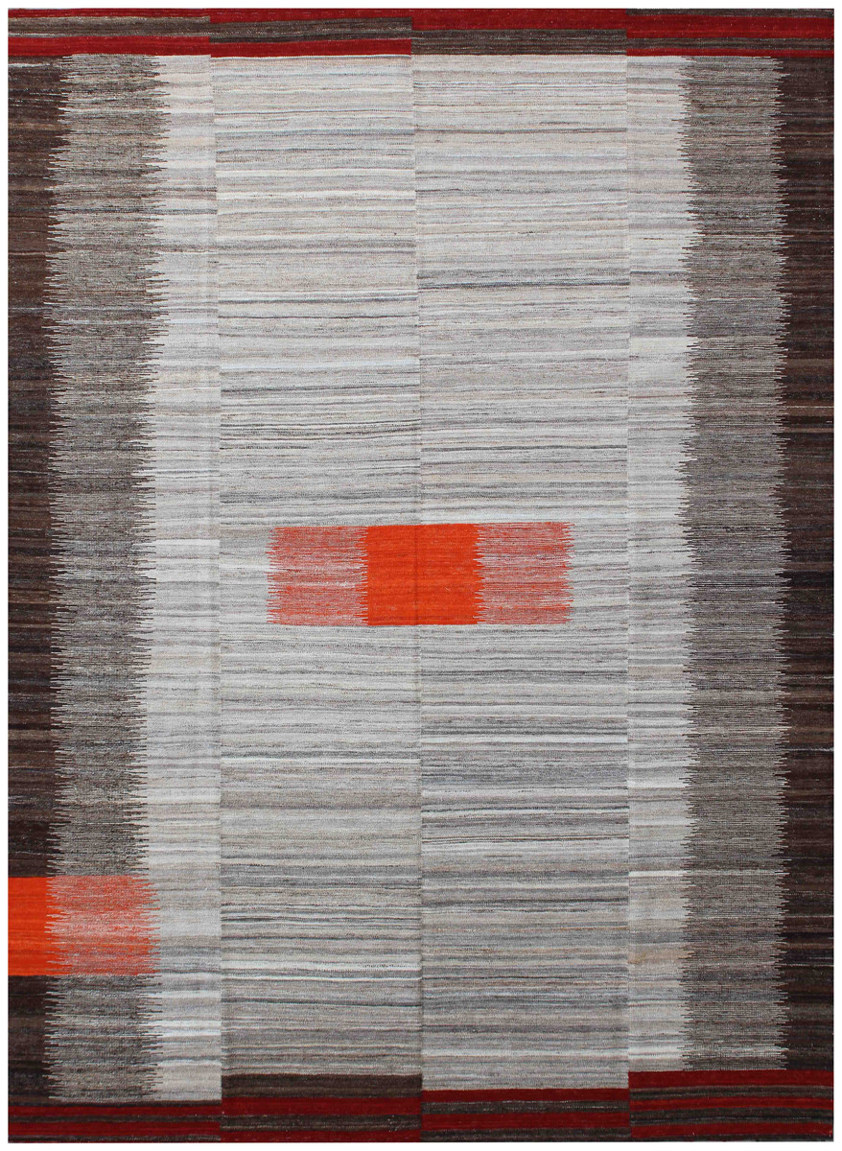
A bright orange rectangle draws attention to the middle of this rug, surrounded by a broad expanse of finely shaded grey. A smaller orange passage sits near one lower side, giving the otherwise balanced arrangement a measured asymmetry. Darker side areas frame the paler centre, while thin red and charcoal stripes define the ends. The whole surface is traversed by small horizontal changes of tone. The size is substantial: at 348 × 254 cm, this contemporary Afghan kilim could bring together a generous sofa arrangement.
Its grey field would be comfortable with neutral upholstery, black metal or darker timber, while the orange offers a concentrated accent. A table with a relatively open base would preserve a view of the central rectangle and its softly changing edges. Geometric textiles occupy an important place in Afghanistan’s domestic furnishing history. Kilims form part of that tradition, alongside smaller woven household objects whose patterns also explore repetition, contrasting compartments and bands.
This rug develops those concerns in a reduced contemporary design, allowing large areas of colour to replace intricate individual motifs. The fine tonal grain is particularly noticeable within the pale centre, where it gives depth to an apparently simple field. Orange and red add warmth without dispersing strong colour across the whole rectangle. This rug would work well where the floor needs a clear visual anchor, with enough quiet space to accommodate furniture and other objects around it.