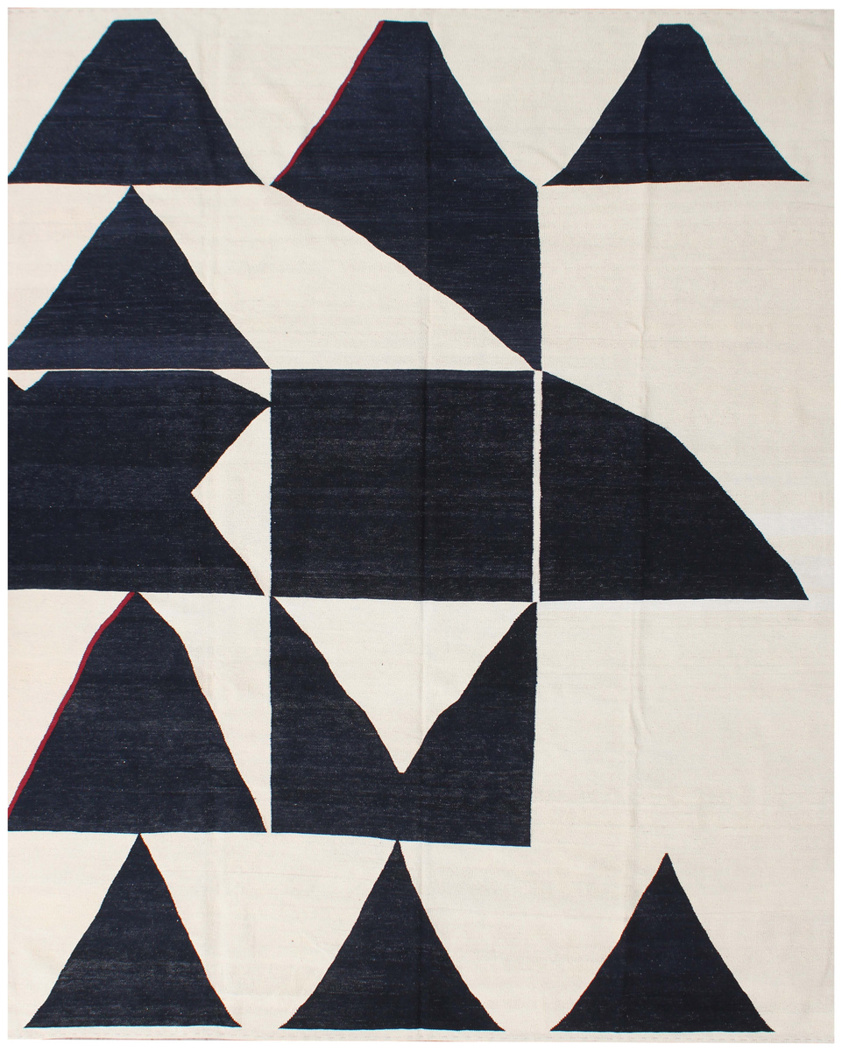
Large navy shapes cut across the ivory field of this contemporary Afghan kilim rug. Triangles repeat along the upper and lower edges, while broader angular blocks occupy the centre. Pale wedges and an inverted triangle interrupt the dark forms, creating a changing balance of filled and open space. A few narrow red accents sharpen selected edges. The composition has a direct graphic quality, but the shapes are not arranged as one uniform repeat. Some are isolated, others meet to form larger silhouettes, and their varying proportions keep the eye moving. Fine tonal changes within the navy give the dark areas a little depth. The ivory remains especially open on one side, providing a useful counterweight to the heavier central forms.
At 390 × 310 cm, this rug has the scale to become a significant element in a large living room. It would work with substantial plain furniture, allowing the larger shapes to remain visible around a table and seating. Dark blue upholstery would connect with the navy, while warm wood or a restrained red object could draw attention to the smaller accents.
Geometry has a long place in the flatwoven furnishings of Afghanistan and neighbouring regions. Contemporary kilims can simplify and enlarge that vocabulary, allowing a small number of shapes to organise a very broad surface. This rug takes that approach with considerable openness, using proportion and the relationship between navy and ivory as its principal decorative tools.