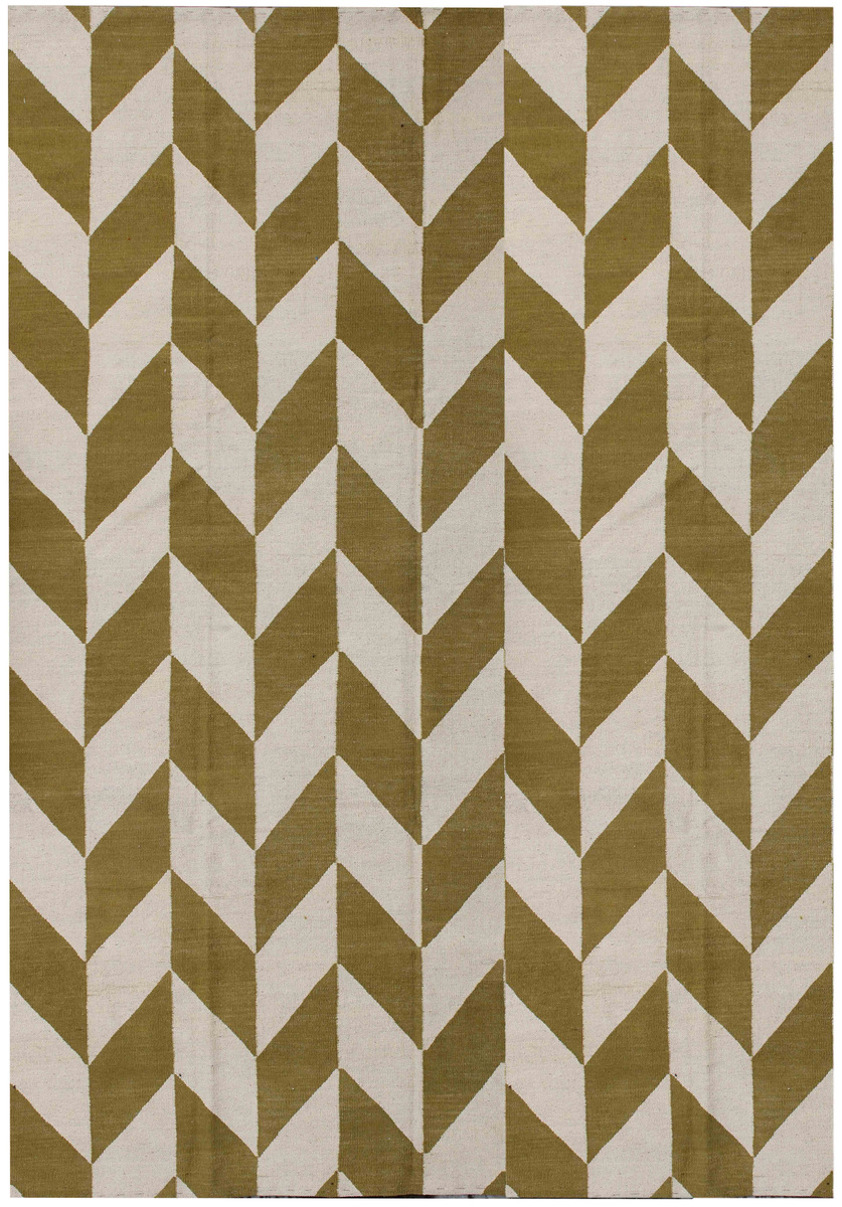
Olive and ivory shapes interlock across this contemporary Afghan kilim rug in broad, repeating chevrons. Their points rise and fall in clear columns, creating a herringbone-like movement along the field. The pattern continues directly to the edges, with no separate border interrupting the colour. Small variations within the olive give the large shapes a lightly textured appearance.
The design has a strong rhythm but uses only a narrow palette. Ivory opens the spaces between the darker sections, making the geometry easy to follow from across a room. Nearby, the slight changes of tone prevent the olive from appearing as a completely flat block. This balance makes the rug useful where a clear graphic pattern is wanted without introducing many different colours. Kilim design in Afghanistan has long made expressive use of angular forms and repeated bands. Contemporary interpretations can enlarge those elements until the geometry becomes the entire composition. This rug follows that approach, using the relationship between pale and dark shapes to provide structure in place of smaller internal motifs.
At 293 × 203 cm, it would sit well beneath a simple seating group or alongside a substantial piece of bedroom furniture. Pale wood could echo the ivory, while green upholstery would create a closer tonal connection with the olive. The directional pattern would remain apparent around a low table, and its unframed edges would allow the repeated shapes to feel continuous across the visible floor.