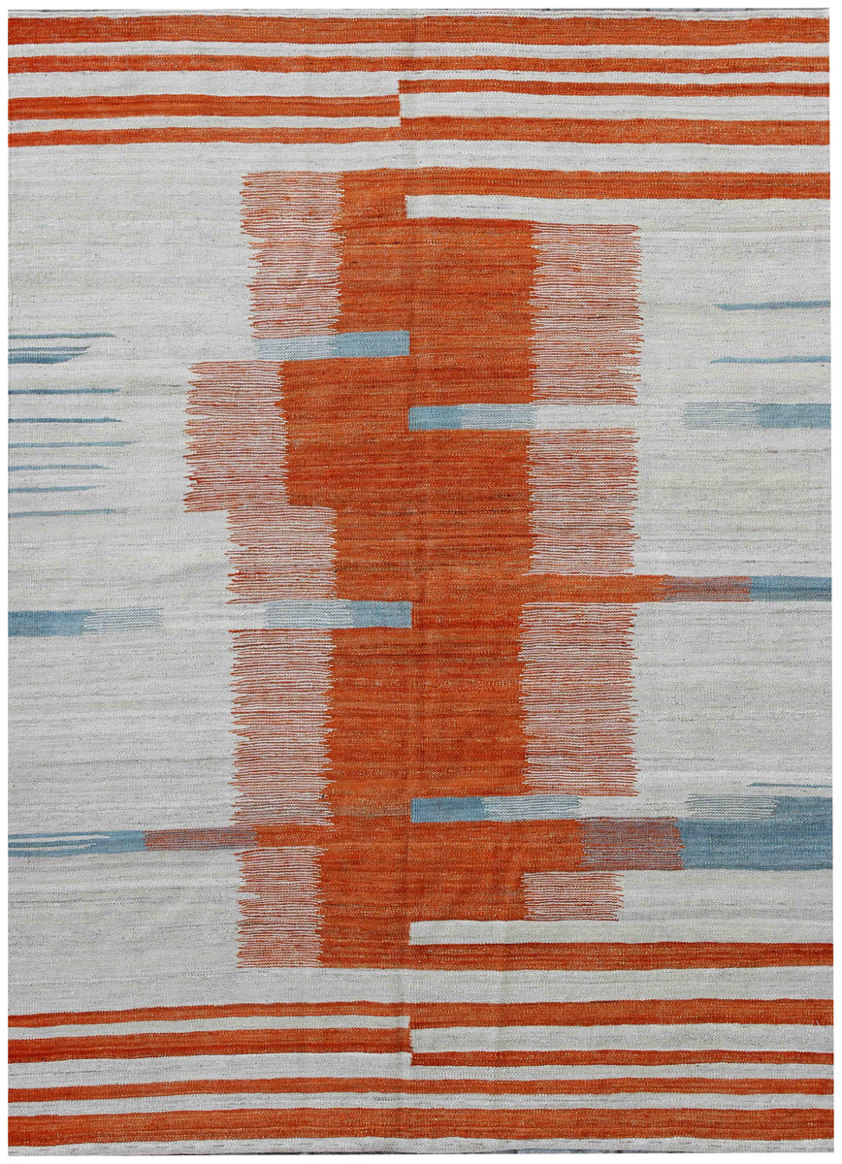
Offset rust-orange blocks form an irregular column through the middle of this rug. Their edges break into fine horizontal marks, allowing ivory to interrupt the colour. Pale blue lines extend into the field from the sides and cut across selected rust passages. At the ends, repeated orange and ivory stripes introduce a more regular rhythm around the freer central arrangement.
Afghanistan’s kilim tradition forms part of the wider history of flatwoven household textiles across Central and West Asia. Bands and geometric divisions have long offered a framework for colour, though their arrangement need not depend on a central medallion or continuous small repeat. This contemporary Afghan example makes the shifts between broad blocks and fine lines its main subject. The little broken edges are important to the effect. They prevent the central column from becoming a uniformly solid shape and create a closer drawing within the restrained palette. A clear section near a chair would show those interruptions, along with the places where a thin blue line crosses a much warmer orange passage. The design uses a small vocabulary but gives each element a different role. Orange provides the main weight, blue makes shorter cool interruptions, and the extensive pale ground keeps the shapes separate.
At 230 × 166 cm, this rug could provide a distinct patterned area beside low seating or within a bedroom. Cream furniture could continue the light background. Alongside it, warm timber would connect with the rust-coloured blocks.