Kilim flatweaving has a long history in Afghanistan and the neighbouring textile cultures of Central and West Asia. Geometric divisions and repeated bands offer many ways to organise a floor covering, ranging from intricate small compartments to much broader colour passages. This contemporary Afghan rug concentrates on the latter, allowing changes of width and tone to carry the design.
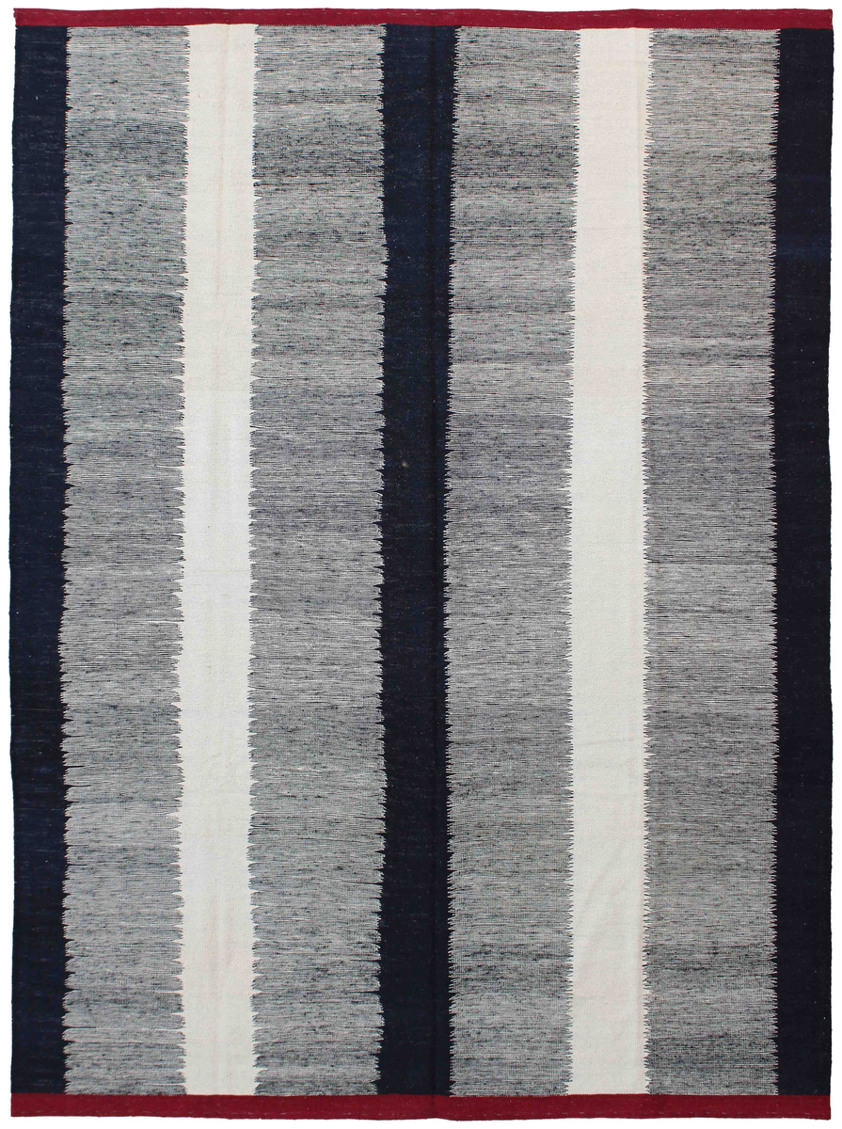
Broad lengthwise stripes give this rug a clear, uncluttered structure. Deep navy bands alternate with fine grey passages and narrow ivory divisions, while a slim red line closes each end. The grey is far from uniform: small horizontal changes of light and dark create a finer pattern within the broad vertical arrangement. Those changing marks are most noticeable beside the solid-looking navy.
The 342 × 255 cm proportions provide a generous rectangle for plain seating. Ivory upholstery could continue the lighter divisions, and a dark blue chair would connect with the strongest stripes. A restrained red object elsewhere could pick up the narrow end detail. The lengthwise direction would remain apparent around furniture even where part of the middle is covered. The red ends are particularly effective because they run across the dominant direction. They establish a definite limit without becoming a wide ornamental border. Nearby, the little horizontal grey marks give the surface more complexity than the large stripes first suggest, while the ivory intervals keep each darker passage clearly separated from its neighbour.