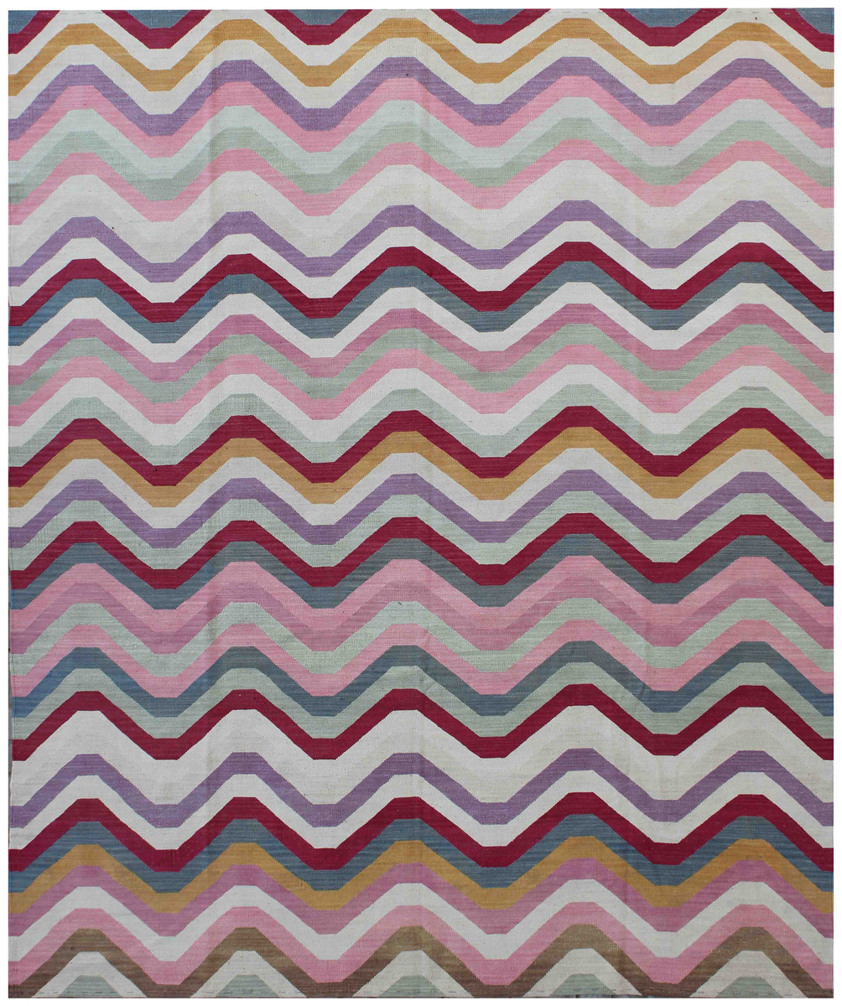
Continuous zigzags carry colour from side to side across this rug. Pink, teal, pale green, cream, ochre and deeper plum repeat in bands of changing width. Some stripes are broad enough to become a significant colour area; others are fine divisions between their neighbours. The pattern extends to the edges without a separate ornamental border. At 298 × 247 cm, this rug has a broad format for a seating arrangement. Plain cream fabrics would give the colours a light setting, while a plum or teal chair could pick up one of the stronger bands.
A simple table would leave the zigzag movement visible beyond its sides. Since the repeat continues throughout the rectangle, the decorative effect remains clear when furniture covers part of the middle. The design is contemporary, but its use of repeated geometry sits within the wider history of kilim flatweaving in Afghanistan and surrounding regions. Bands and angular changes of direction have offered many ways to organise colour across a woven surface. Here, the line itself is the principal motif, with no medallion or scattered flowers interrupting its progress.
The shifts between deep and pale colours are especially effective at the points where the stripes turn. Plum gives a definite outline to selected passages, while pink and cream make broader, quieter intervals. Small changes in contour keep the zigzags lively without disturbing their overall consistency. The result is an evenly distributed pattern whose interest depends on the changing weight and colour of each successive band.