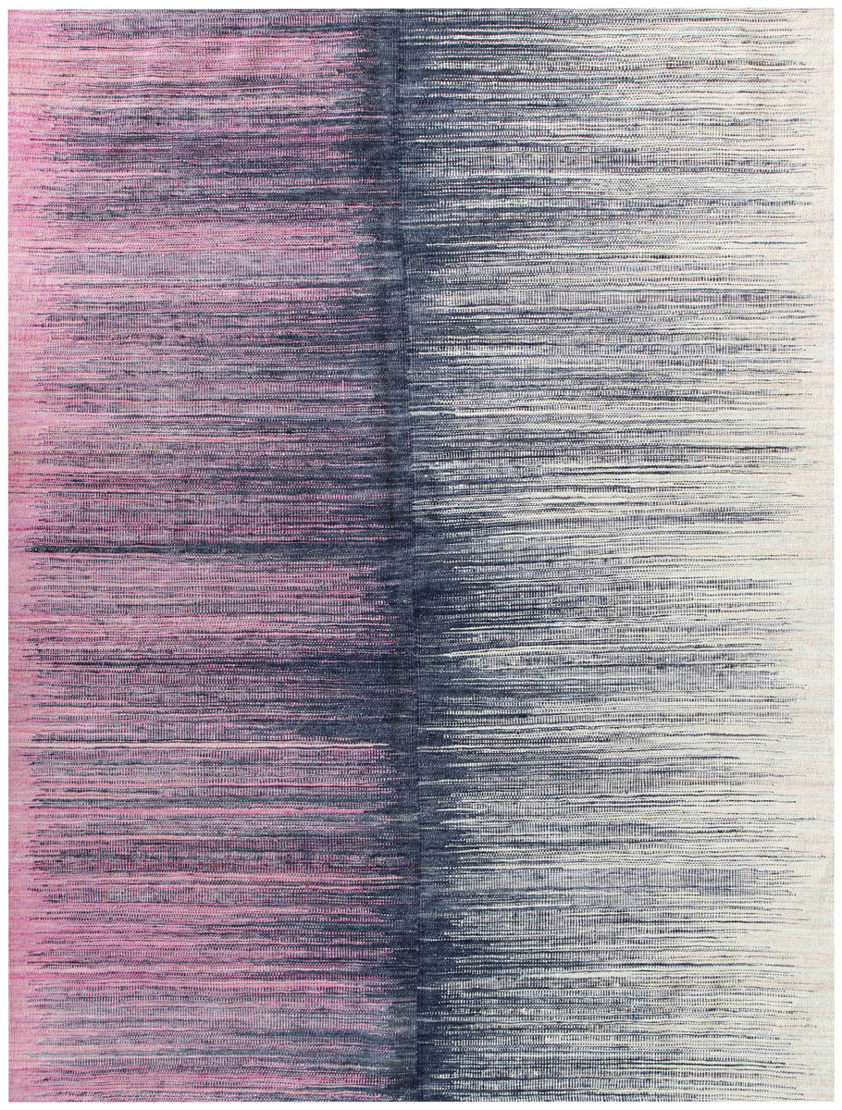
Pink fills the left-hand side of this rug, passing through a dark blue-grey middle towards a much paler opposite edge. Fine horizontal lines run across those broad colour areas. Some extend far into the lighter ground, while others stop close to the central passage. The result is an abstract field with a particularly clear change from warm to cool and light. There is no separate border. Pink, charcoal and pale grey continue directly to the sides and ends, leaving their relationships uninterrupted. The dark middle has the greatest concentration of closely spaced marks.
At either side, the strokes are more easily distinguished against the lighter colour, giving the surface a finer visual texture nearby. Afghan kilim design can explore colour through broad divisions as readily as through small repeated motifs. In the wider history of flatwoven furnishings, bands have provided a simple framework for many different decorative treatments. This contemporary rug makes their boundaries deliberately fluid, using numerous narrow lines to carry colour between the larger areas.
At 231 × 175 cm, this rug would suit a small living area or a position beside a bed. Grey furniture would connect with its cooler half, allowing pink to supply the main accent. An exposed pale section could give breathing space beside a darker chair. The progression across the width would be most apparent where the rug remained visible on both sides of a central table.