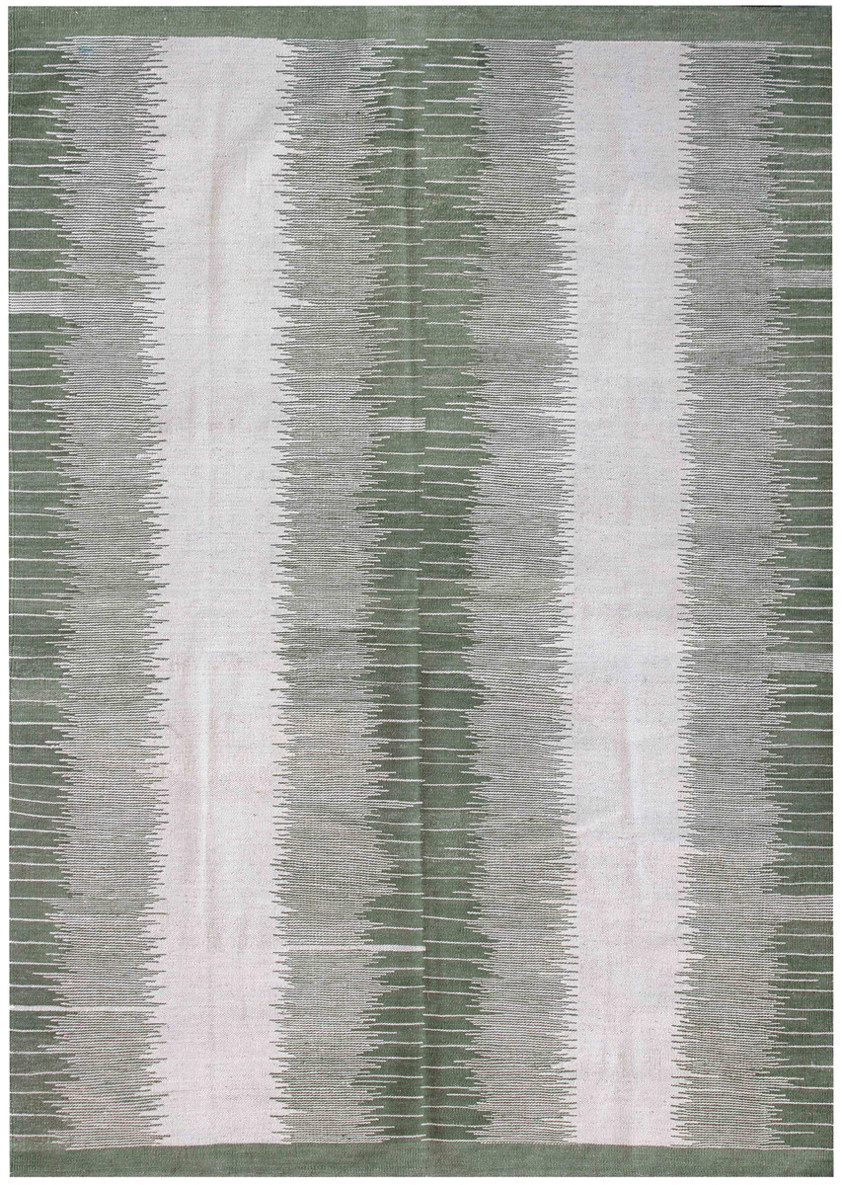
Fine broken marks give the stripes on this rug a gently uneven edge. Green and grey passages sit beside broad ivory columns, with short horizontal strokes entering the lighter ground. The green is deeper around the perimeter and along parts of the middle. Grey softens the intervening bands, keeping the palette quiet despite the definite striped structure. Unlike a sharply divided colour arrangement, this field changes continuously along each boundary. Some marks barely reach into ivory, others extend farther across it.
The wider pale areas provide a little relief from that closely drawn surface. A simple green edge contains the composition at either end, without adding a separate patterned border. Stripes are a versatile element within the flatweaving traditions associated with Afghanistan. They can establish direction and proportion with relatively few colours, leaving small differences of line to enliven the surface.
This contemporary Afghan kilim places those differences at the centre of its design, using the meeting of ivory, green and grey as its main decorative event. A bedroom with plain fabrics would provide a quiet setting for this 233 × 165 cm rug; light wood would suit it equally well in a small sitting area. A green-painted piece could make a direct colour connection. The ivory columns would keep the floor looking comparatively open. Their long direction would also give a clear visual line through the room, even where part of the field was covered by furniture.