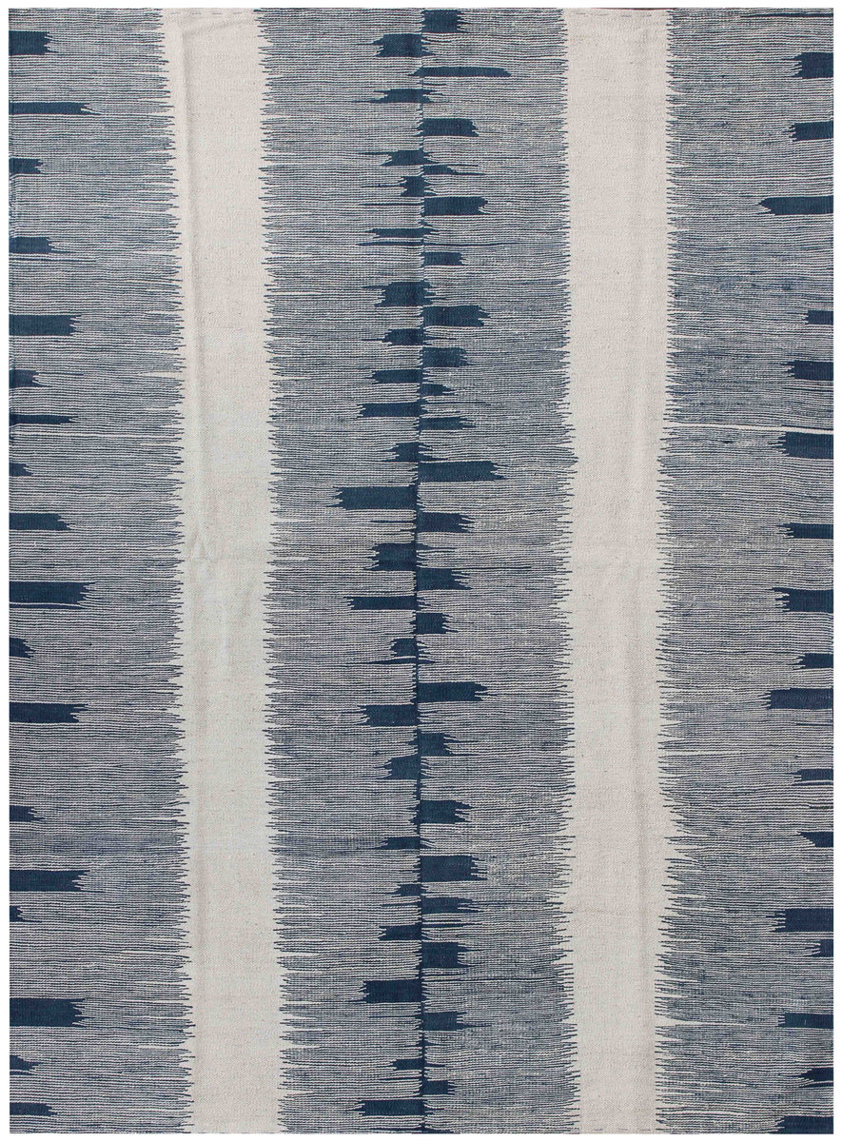
Small navy dashes form a broken line through the middle of this rug. They interrupt a finely striped grey ground, with broad ivory bands running along either side. Further dark marks appear near the outer edges. Their unequal lengths give the composition a livelier rhythm than a regular sequence of straight stripes would provide. The ivory areas are comparatively open. They offer light intervals between the closely drawn grey passages and make the small dark shapes easier to distinguish.
Across the centre, some dashes project to one side and others to the opposite side, so the line seems to shift as it travels down the field. There is no additional ornamental frame. Simple bands and small geometric interruptions have a natural place within Afghan kilim design. The wider history of flatweaving includes many ways of organising a surface through colour divisions, with pattern sometimes concentrated at their boundaries.
This contemporary Afghan rug makes that boundary its most distinctive feature, using scattered navy marks to complicate an otherwise restrained arrangement. The 233 × 171 cm rectangle could define a compact seating corner or a bedroom floor area. Grey upholstery could connect with its finer passages, and ivory curtains would refer to its lighter bands. Navy need only appear in one or two nearby objects. Where the central line remains uncovered, its succession of short dark forms would provide a particularly clear point of interest.