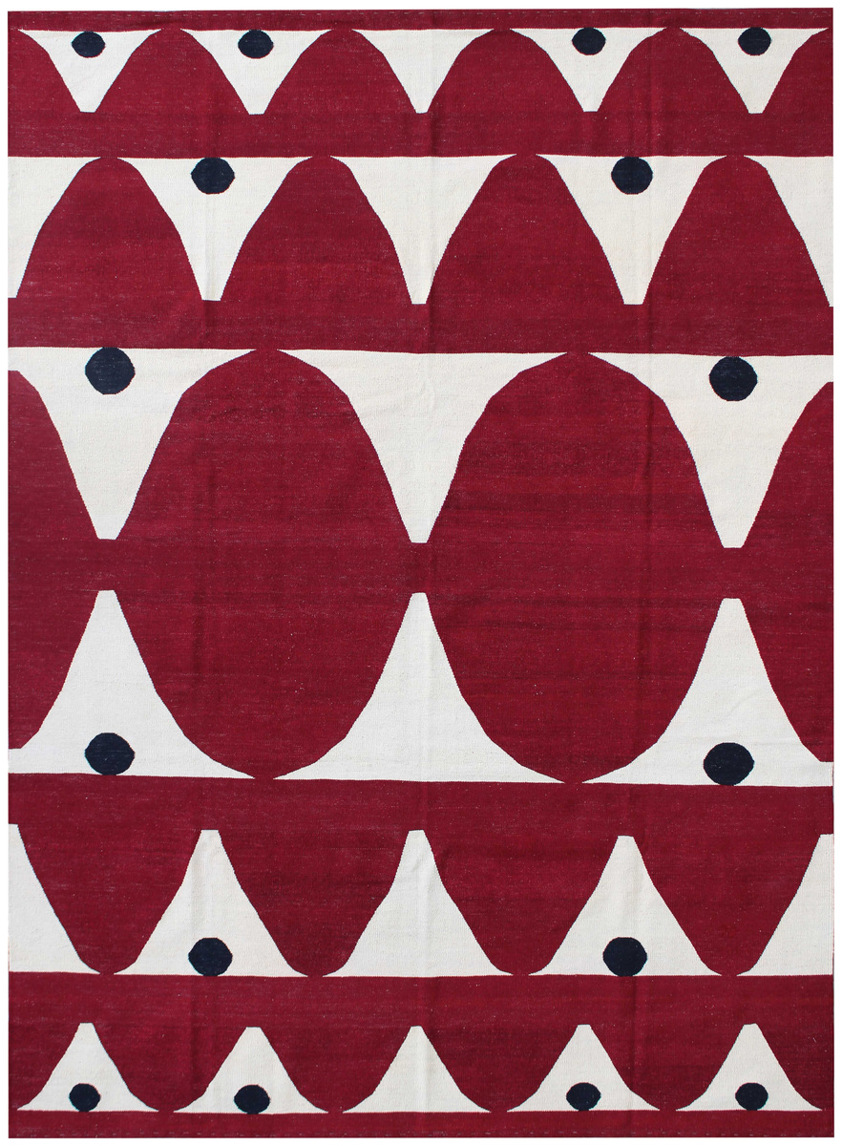
Red curves swell into the cream ground of this rug, producing large rounded shapes between much sharper pale points. The rows vary considerably in scale. Narrower forms gather near the ends, while the middle contains the broadest curves. Small dark blue dots occupy selected cream spaces, adding a third colour without complicating the strong red-and-cream arrangement. The geometry has an almost cut-paper clarity when viewed across a room. Nearby, small tonal variations within the red reveal a less uniform surface. Horizontal red bands divide the principal rows and give them a definite sequence.
The largest cream points are long and open, making the pale ground as active as the coloured shapes. This contemporary Afghan kilim uses a reduced geometric vocabulary rather than the many small motifs found in some traditional flatweaves. Kilim design across Afghanistan and neighbouring textile cultures has ample scope for both approaches. Here, proportion does much of the decorative work: repeating a related curve at different sizes creates variation without sacrificing the overall simplicity.
Its 345 × 253 cm dimensions would suit a generous living area. Plain cream furniture could relate to the pale intervals, while dark blue ceramics would pick up the dots. The red would carry the main colour statement and needs little repetition elsewhere. A clear section through the middle would preserve the meeting of the largest curved forms, which gives this rug its most expansive passage.