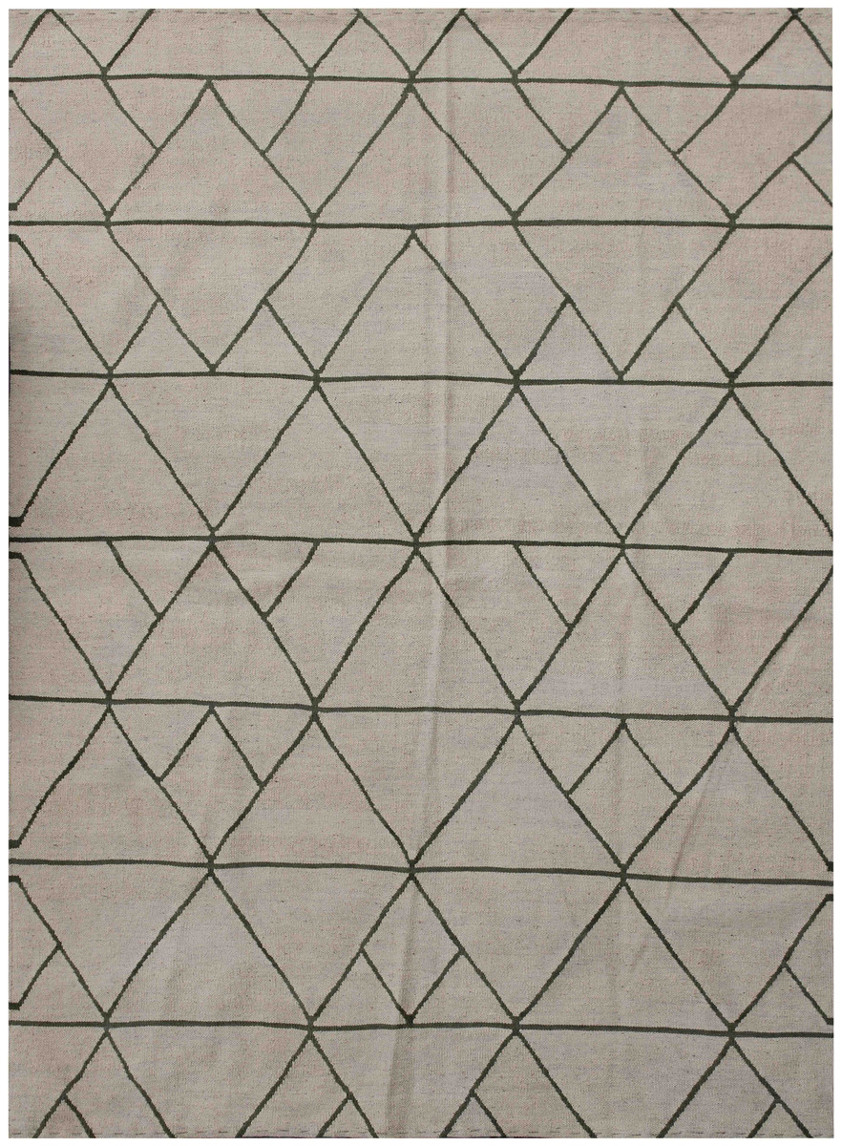
Fine green lines form a loose geometric network over the taupe ground of this rug. Long diagonals cross between horizontal divisions, creating open triangles and larger diamond-like intervals. Their angles vary slightly, so the pattern never settles into a perfectly regular grid. The lines meet the perimeter directly, with no broad contrasting border. Afghanistan's flatweaving traditions include a wide vocabulary of angular arrangements, often built from the relationship between simple lines and adjacent colour areas. Contemporary kilim design can give those familiar forms much more open spacing. Here, the larger empty intervals are integral to the composition, allowing an economical network of lines to organise the whole field.
At 236 × 173 cm, this rug could add quiet pattern to a bedroom or an informal sitting corner. Natural oak, linen and muted green fabrics would make useful connections with its palette. Furniture with rounded shapes could offer a gentle counterpoint to the diagonals. Since the drawing is spread throughout the surface, an armchair or small table could overlap the centre while leaving related junctions and open triangles visible around it. The taupe ground is generous and relatively quiet. Small tonal changes are visible within it, giving the open spaces more character than a flat plain surface. Green supplies a restrained distinction rather than a strong colour contrast. The slightly uneven drawing is particularly noticeable where several diagonals meet along a horizontal line.