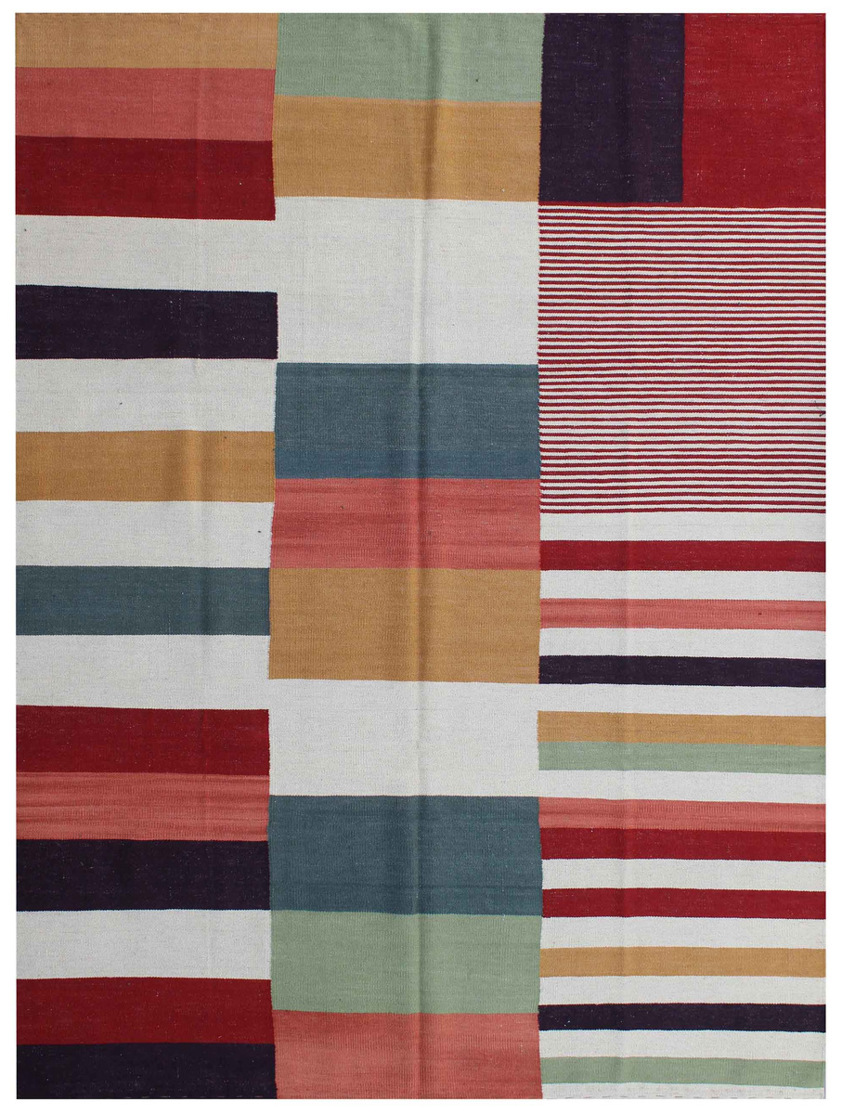
Broad rectangles and fine stripes give this rug two quite different scales of pattern. Red, ochre, pale green, muted teal and deep purple appear in an uneven arrangement of blocks, separated by generous ivory passages. The right-hand section introduces closely spaced red lines, then opens into broader coloured stripes towards the lower end. There is no enclosing ornamental border. The composition has the freedom of an abstract painting, although the individual sections remain clearly organised. A dark horizontal block interrupts the pale area on the left, while a teal rectangle provides a quieter centre.
Changes in the width and spacing of the bands stop the three main vertical divisions from becoming predictable. Slight tonal movement is visible within several of the larger coloured areas. Afghanistan's flatweaving belongs within a wider Central Asian textile landscape in which bands, geometric forms and contrasts of colour have long been important. Kilims use an interlaced structure that makes such divisions integral to the surface.
This contemporary Afghan example develops those basic relationships into an expansive arrangement of rectangles, balancing small lines against substantial areas of colour. At 289 × 198 cm, this rug could sit beneath a coffee table with much of its changing pattern still visible. It would work particularly well with simple furniture profiles and a limited selection of surrounding colours. The ochre and red could warm a pale room, while the green and teal offer quieter connections to upholstery, artwork or painted joinery.