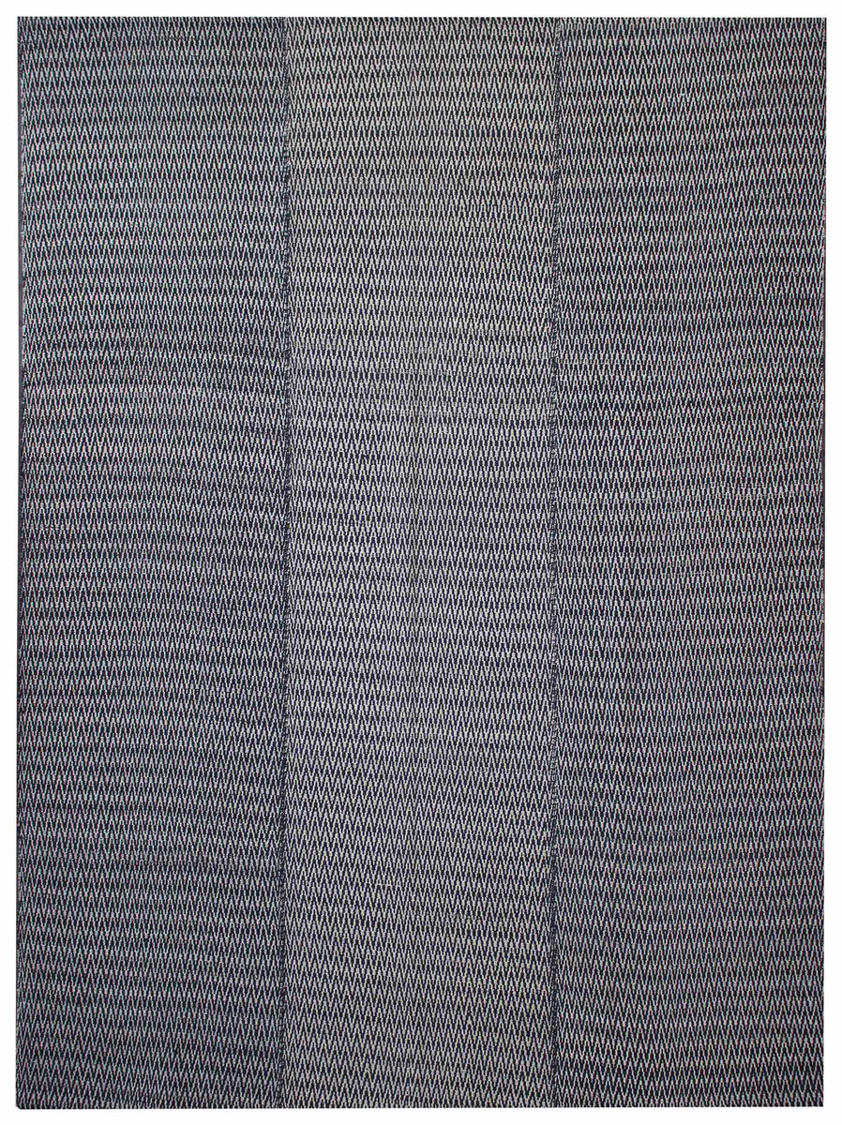
Fine charcoal and pale chevrons cover this rug in a close, sustained repeat. The zigzag lines are small enough to merge into a finely patterned surface from a distance, while their individual direction becomes clear nearby. Subtle vertical divisions create a second rhythm through the field without interrupting the overall continuity.
This rug has considerable scale, measuring 244 by 298 centimetres, but its limited palette keeps the pattern restrained. It could sit beneath a dining table or provide a consistent foundation for a substantial seating arrangement. Warm wood would soften the charcoal, while pale upholstery would relate to the lighter lines. The repeat remains visible wherever furniture leaves the floor exposed. Kilims belong to the longstanding flatweaving traditions of Afghanistan and neighbouring regions.
Geometric patterns can be created through clear relationships between colour and line, ranging from broad bands to very small repeated units. This contemporary Afghan kilim rug uses the latter approach, allowing a minute chevron to build a much larger field. There is no central medallion or broad contrasting border. The interest comes from following the regular zigzags and noticing the quieter changes in density between different passages. This rug would be especially effective in a room with larger, simpler shapes, where its finer scale could provide a measured counterpoint. Close inspection reveals a precise directional pattern within a surface that initially appears almost neutral, giving the restrained composition more depth than a plain dark field.