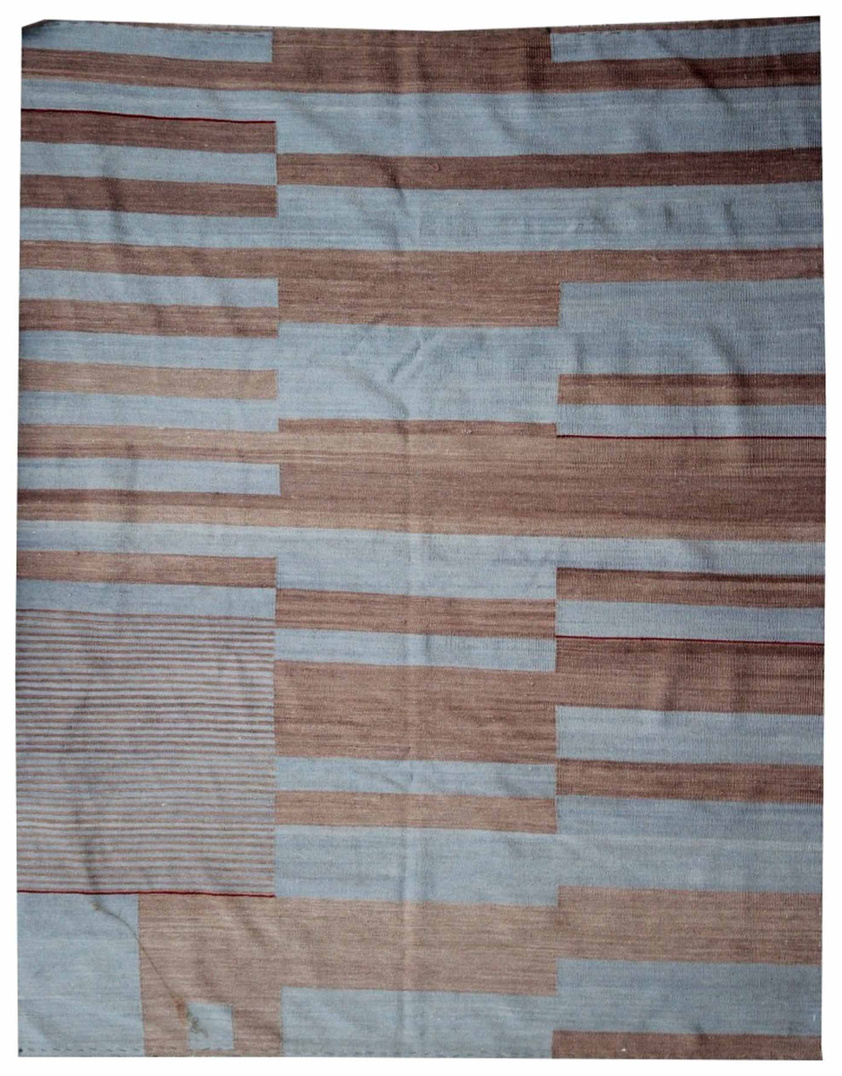
Pale blue and taupe bands meet in an arrangement of offset rectangles across this rug. Muted rose notes warm the lighter colours, while occasional finely striped sections introduce a closer texture of line. The bands vary in width and length, ending in small steps that prevent the design from reading as a simple set of horizontal stripes.
As a contemporary Afghan kilim rug, this example belongs to a flatweaving tradition that lends itself to strong divisions of colour. Across Afghanistan and the surrounding region, kilims have served as practical domestic textiles as well as patterned floor coverings. Here that geometric vocabulary is interpreted through softened colour and an open, asymmetrical arrangement rather than closely repeated small motifs. This rug has an unusually quiet treatment of geometry. Its forms are clear, but the colours remain close enough for the divisions to feel gentle. Narrow lined passages sit beside broad open blocks, providing detail without making the composition busy. The pattern continues to the edge, with no distinct border interrupting the relationship between the horizontal elements.
The relatively broad 184 by 227 centimetre shape would suit a modest seating group or an open area in a bedroom. Light oak and cream upholstery would suit its gentle tones. The muted rose could also be drawn into a room through a small upholstered chair or painted piece, leaving the blue bands to provide the cooler balance across the floor.