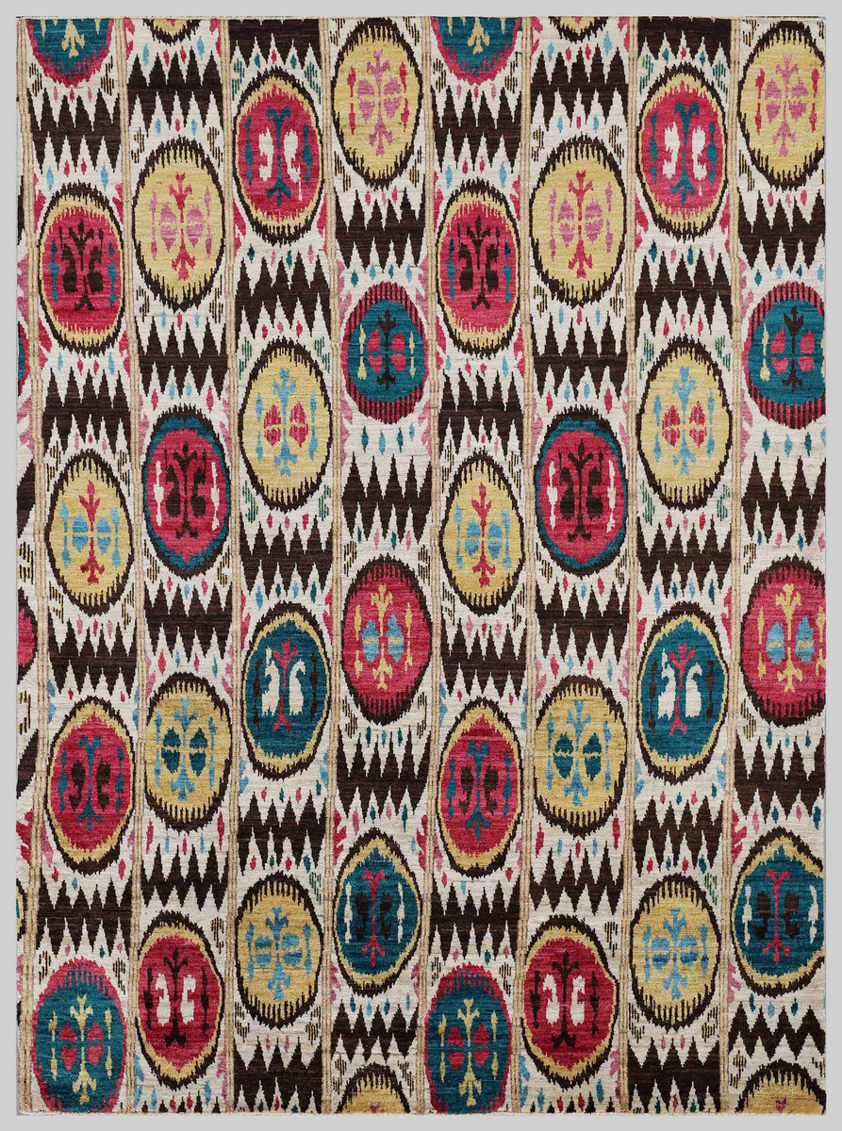
Bold red and gold ovals provide the main accents on this rug, joined by deeper teal examples with bright contrasting centres. Little paired shapes, crosses and curved forms distinguish the individual roundels. Between them, black points rise and fall through ivory bands, creating a close vertical rhythm. The colours alternate across the field without forming a single central focus. The decorative reference comes from Ikat textiles, whose striking patterns are closely associated with Central Asia, including Uzbekistan.
Historically, their designs were developed through repeated binding and dyeing of threads before weaving. This Afghan rug draws on their visual vocabulary, giving the enlarged ovals irregular edges and surrounding them with a strongly animated background.
Its 240 × 175 cm proportions would work in a study or a smaller sitting room where the pattern could be seen at close quarters. Plain furnishings would let the different roundel centres remain apparent. Gold or red details elsewhere could bring out the warmer colours, while teal offers a cooler alternative. The black-and-ivory passages are an important part of the design rather than simply empty space around the ovals. Their narrow points make the larger coloured forms seem fuller and more rounded. Leaving a clear area along one long side would show that relationship particularly well, allowing several complete motifs and the changing intervals between them to be appreciated together.