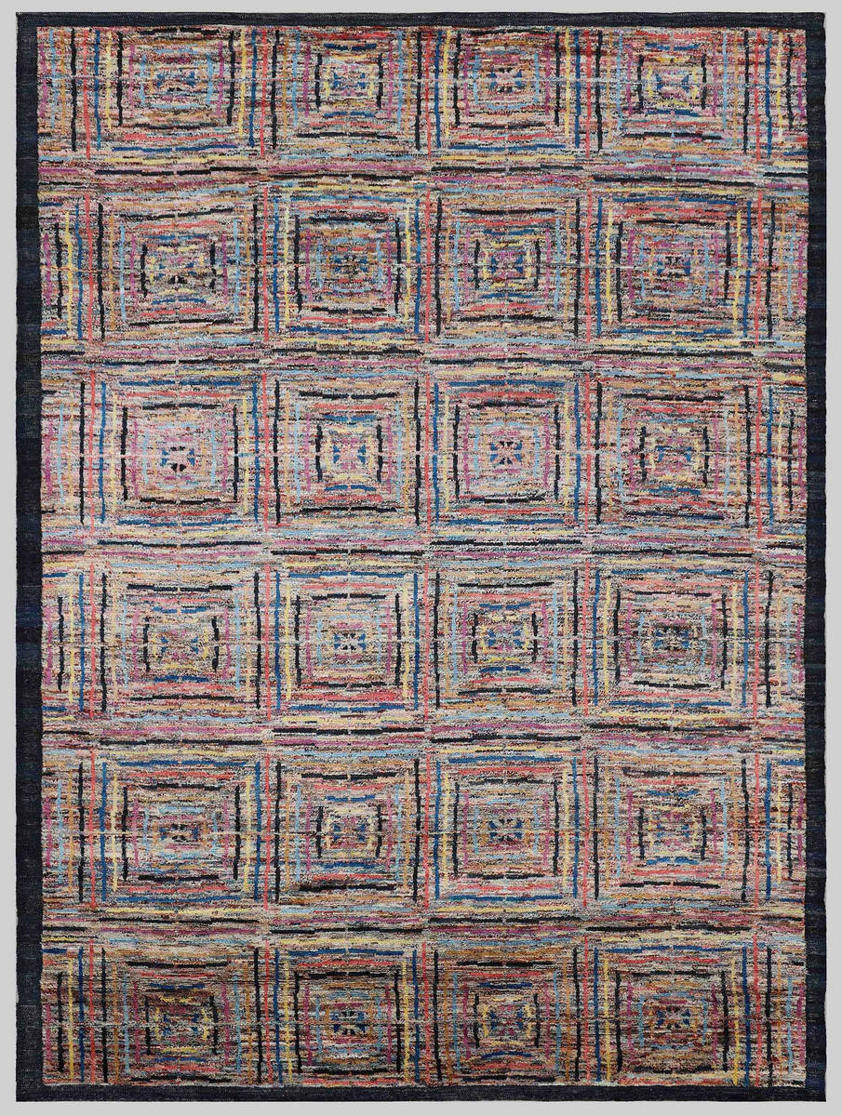
Multicoloured concentric squares fill this rug in closely arranged rows. Each compartment contains numerous fine lines in red, blue, ochre, cream and darker tones, with small changes of spacing and colour from one square to the next. Narrow divisions connect the compartments into a grid.
A dark outer frame gives the busy interior a definite boundary. The lines are sufficiently varied to make every compartment feel slightly different. Some centres appear darker, others lighter, and the smaller marks often break or change direction before completing an exact outline. From across a room the rug reads as a richly textured grid; nearby, the individual colour sequences become much more apparent. The historical background of Gabbeh lies in domestic rug weaving in Iran’s western and southwestern regions, with expressive geometry and broad uses of colour among its historical characteristics. This contemporary Afghan rug develops the geometric reference into a much finer, more densely articulated design. Repetition supplies the structure, while the little differences within each square provide the decorative variety.
Measuring 373 × 272 cm, this rug could support a large seating group without depending on a central medallion being left uncovered. Plain sofas would allow its fine pattern to remain legible around them. A darker wooden table could connect with the frame, and a single red or blue object would pick up one part of the palette. The many related compartments give considerable freedom over furniture placement.