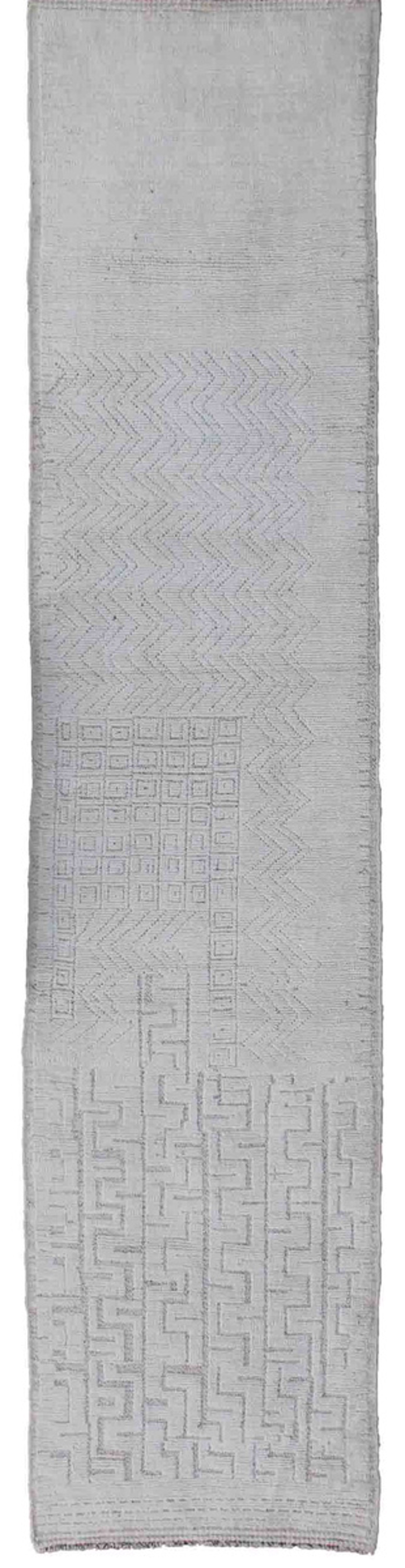
Delicate chevrons lead into squared, interlocking lines along this ivory runner. The upper part is relatively open, with close fine marks becoming more apparent through the middle. Towards the lower end, small angular paths gather into a denser network. Slender end bands finish the narrow rectangle without introducing a strong contrasting frame.
The runner's appeal depends on gradual changes rather than bold colour. In some places the grey drawing almost merges with the ground; elsewhere the little turns are easier to follow. That difference gives the long surface a sense of progression, with the more clearly patterned end providing a quiet point of emphasis. Geometric textile designs are an important aspect of Amazigh material culture in North Africa, the source of the Berber style reference. Their vocabulary includes straight lines, repeated turns and many different arrangements of small shapes. This Afghan runner gives those broad ideas a restrained contemporary treatment, using very fine marks within an unusually light overall palette.
The 398 × 90 cm format would provide a light connection between adjoining rooms. It could also sit alongside a long bank of cupboards, where its subtle drawing would add detail without competing with the joinery. The pattern is best appreciated with a little bare floor visible around both long edges. Soft grey walls would relate to the fine lines, while a few darker objects could give the pale composition a more defined setting.