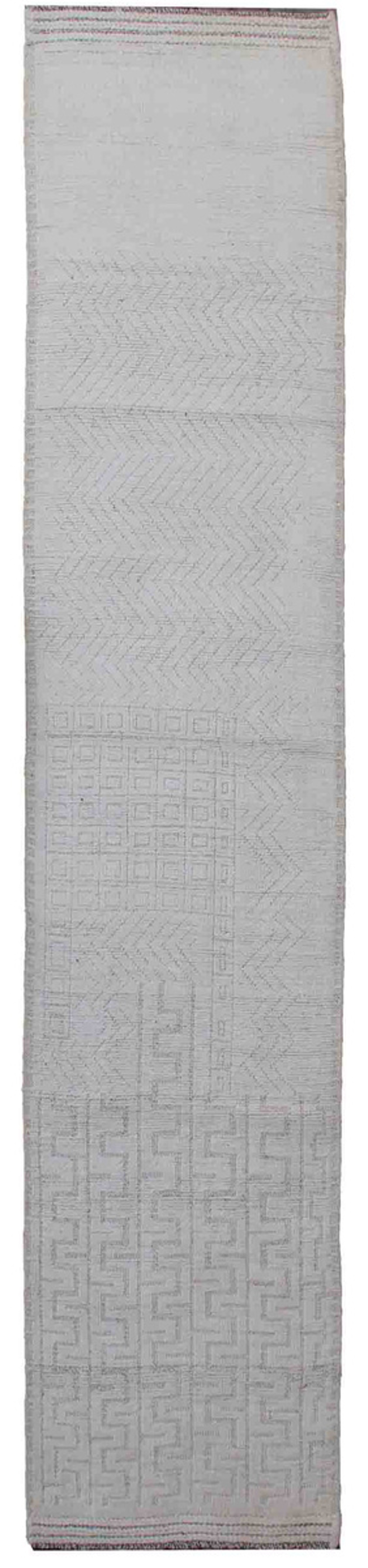
Fine grey geometry gradually becomes clearer along the pale field of this runner. One end is relatively open, followed by close chevron-like lines and then more angular, interlocking squared forms. Several patterns overlap in their transition rather than ending at a sharply defined boundary. Narrow bands of muted colour finish the short ends.
The effect is restrained and depends on small changes of line. At a distance, this runner would read mainly as a light surface. Nearby, the repeated turns and little rectangular paths become more apparent, giving the lower section a denser decorative character than the upper part. The field remains pale enough to connect those different areas. Berber style is a design reference to the varied textile cultures of North Africa's Amazigh communities. Geometry is an important part of that visual language, appearing in many arrangements rather than one fixed pattern. This Afghan runner interprets the reference through very fine drawing and an unusually quiet contrast, concentrating attention on the transition between its separate geometric passages.
Measuring 373 × 89 cm, this runner would suit a long hall where a light floor accent is wanted without a strong block of colour. Plain timber furniture and softly painted walls would allow its subtle marks to remain visible. The more densely drawn end could be placed where it is approached most closely, such as near a doorway or console, giving the changing pattern a practical relationship with the space.