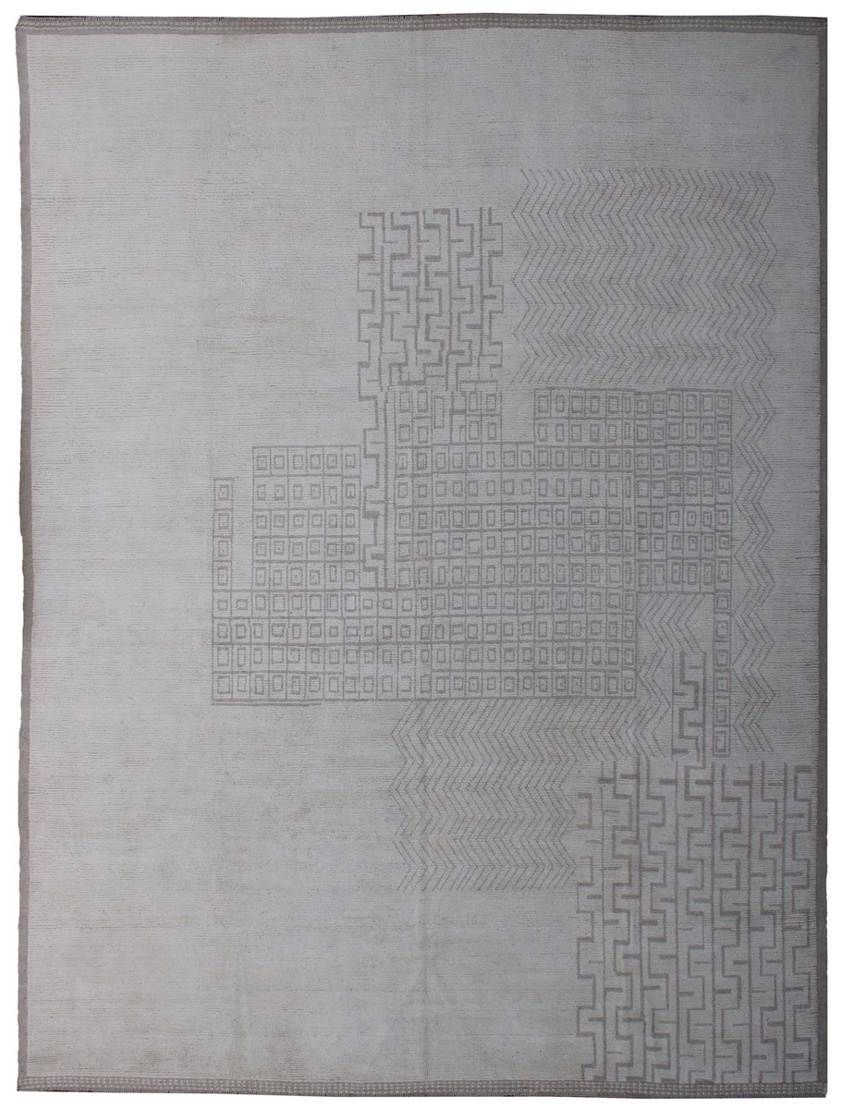
An open pale field gives this rug a spacious character, with its fine grey pattern concentrated towards the right. A broad patch of tiny squares meets taller passages of interlocking angular lines. Closely spaced chevrons sit above and below parts of the grid, producing several different scales of detail. A subdued grey edge keeps the large rectangle clearly defined.
At 410 × 310 cm, this rug would provide a substantial light base for a large sitting room. Furniture could occupy the quieter left-hand area while leaving more of the patterned side exposed. Soft grey upholstery would connect with the drawing, and a dark table or sculptural chair could stand clearly against the open ground. The Berber style name refers to a broad Amazigh decorative heritage from North Africa, where geometry is an important part of textile design. Its range includes both sparse arrangements and densely articulated patterns. This Afghan rug brings those two qualities together, setting compact geometric passages within a much larger area of light colour. The junctions between the patches are worth noticing.
Small squares end against a taller maze-like section, while the chevrons introduce diagonal movement beside squared turns. Those transitions prevent the pale surface from feeling uniform. A room with measured contrasts and relatively plain curtains would allow the differences to remain visible, especially where the denser pattern emerges around the edge of a furniture group.