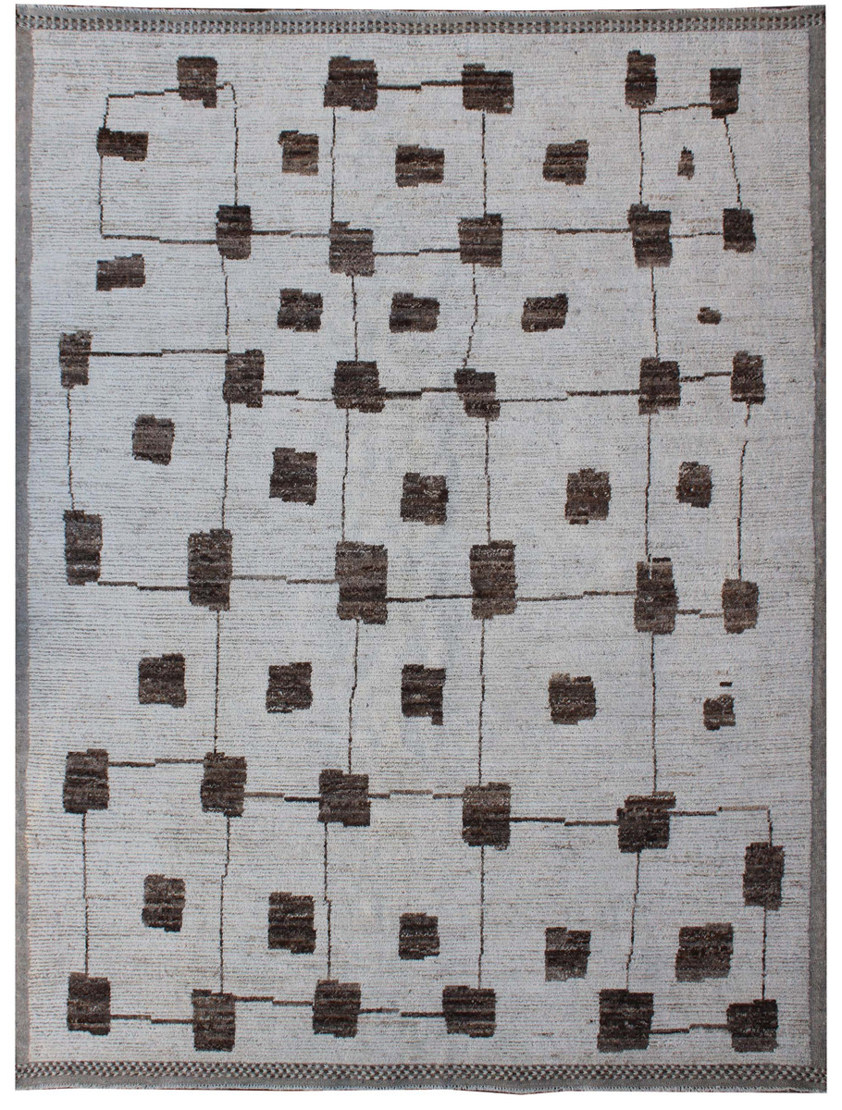
Uneven brown squares form loose junctions across the ivory field of this rug. Fine lines connect many of them, creating an irregular network of rectangular spaces. Other small blocks sit independently between the larger linked forms. Their widths and positions vary, and several have broken or stepped edges. A narrow border repeats much smaller dark marks around the whole arrangement. The design has a drawn quality: some connections are long and spare, while others stop close to a neighbouring square. Brown varies within the blocks, introducing a little warmth and texture into the simple palette. Ivory keeps the network legible and gives the isolated shapes room to register.
Geometric ornament is a shared feature of many North African Amazigh textiles, the wider source of the Berber style designation. Across that diverse heritage, repeated signs and linear arrangements appear in numerous combinations. This Afghan interpretation concentrates on the square and the connecting line, giving those simple elements an informal contemporary organisation.
Measuring 300 × 216 cm, this rug could sit beneath an open-legged dining table or within a living room furnished in natural tones. Its pattern is spread throughout the field, so it does not require one central ornament to remain uncovered. Walnut, dark oak or brown leather would relate to the stronger blocks. The narrow outer border would provide a useful visual edge where the rug meets a plain floor, preserving a clear boundary around its looser interior network.