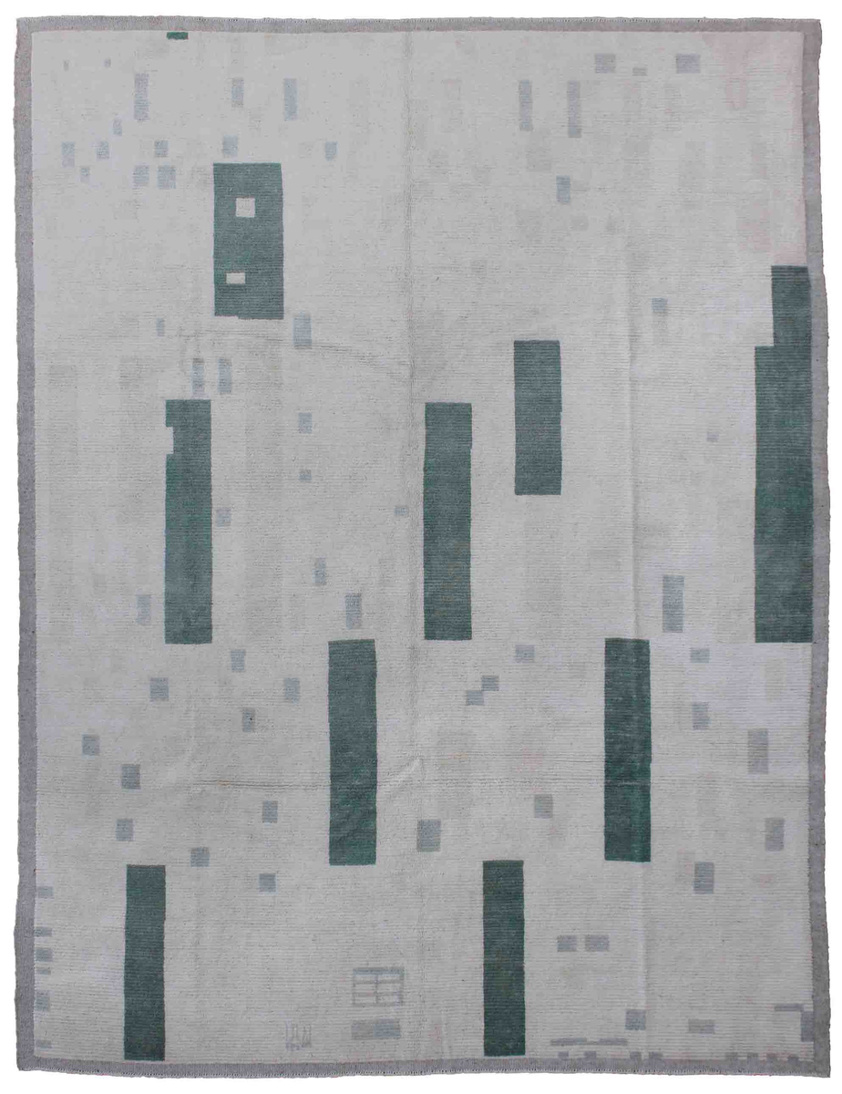
Spaced green bars provide the clearest accents on the very pale field of this rug. Their lengths and positions vary, with some starting at the edge and others floating within the interior. Fainter grey blocks, tiny squares and occasional grid-like marks fill selected intervals. A grey perimeter gives the sparse composition a quiet boundary.
At 367 × 272 cm, this rug offers a substantial area of light colour for a large living room. Its open design would accommodate varied furniture shapes, allowing a sculptural chair or a strongly grained table to remain prominent. Muted green upholstery could connect with the bars, while light curtains would continue the spacious impression of the ground. The Berber style designation is a reference to North Africa's Amazigh textile heritage, where geometry forms part of an extensive decorative language. That heritage includes numerous regional and individual approaches to pattern. This Afghan interpretation is particularly spare, reducing the drawing to scattered bars, small compartments and delicate changes of tone. The emptier passages are central to its character.
They give the stronger green marks room to register, while the small grey details prevent the pale surface from becoming featureless. A few bars are interrupted by tiny light openings, adding another scale of interest. Furniture placement can make use of those differences: leaving one or two longer green sections exposed would preserve the design's main rhythm even where much of the lighter centre is occupied.