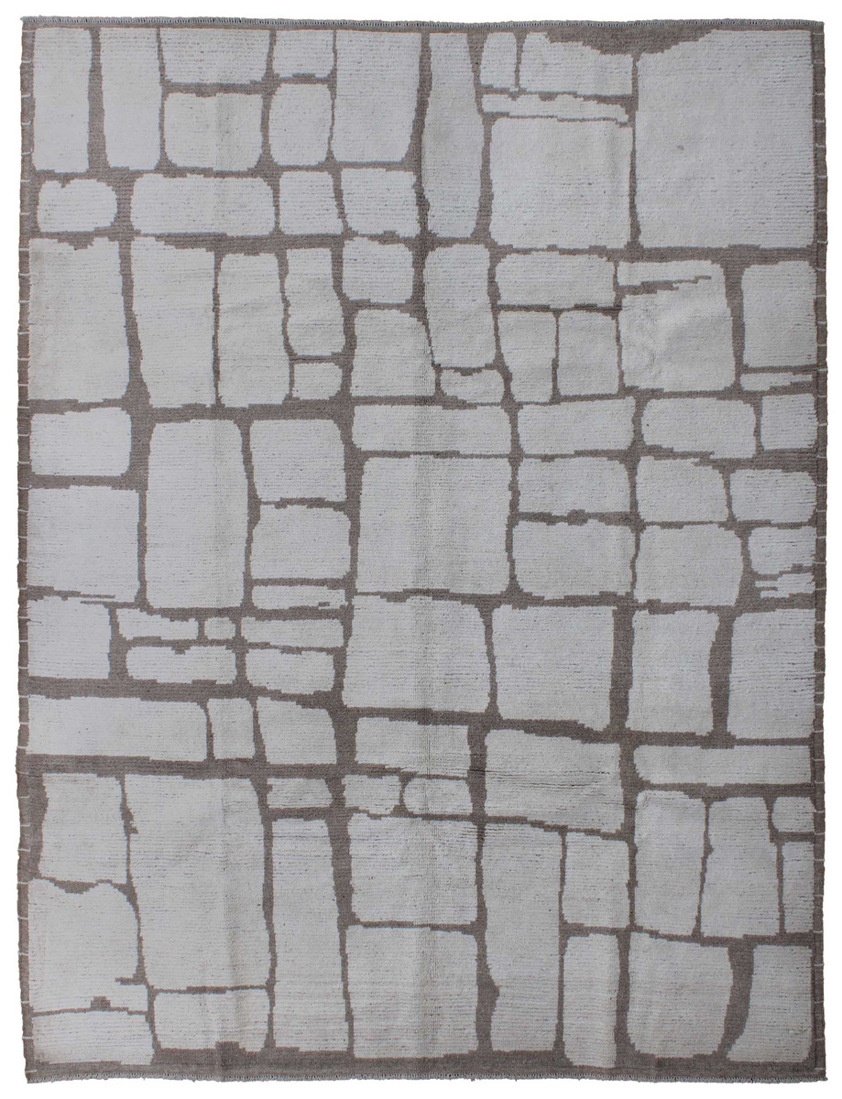
An irregular network of grey lines divides the cream surface of this rug into unequal rectangles. Some compartments are tall and open, others compact and closely grouped. The lines broaden at several intersections, while a grey perimeter encloses the changing grid. Small departures from straightness give the drawing a relaxed, almost sketched character. The Berber style reference relates to the geometric ornament of Amazigh textiles in North Africa. Across that varied decorative culture, lines, diamonds and other simple shapes appear in textiles as well as different forms of material art. This Afghan rug takes the reference in a more architectural direction, using an uneven arrangement of rectangular spaces within a restrained grey-and-cream palette.
At 297 × 247 cm, this rug could sit comfortably beneath a substantial seating group. Furniture with rounded profiles would provide an interesting counterpart to the grid, while a simple rectangular table could follow its geometry. The cream areas keep the surface light, and grey fittings or upholstery would connect with the darker network without requiring a strong colour scheme. The most engaging feature is the variation in scale. Narrow compartments gather along one edge before opening into wider spaces, and short cross-lines interrupt several larger rectangles. The surface therefore remains active even though the colours stay quiet. A plain surrounding floor would show those changes clearly. Leaving some of the smaller compartments exposed beside a sofa would allow the less regular passages to contribute as much as the larger central divisions.