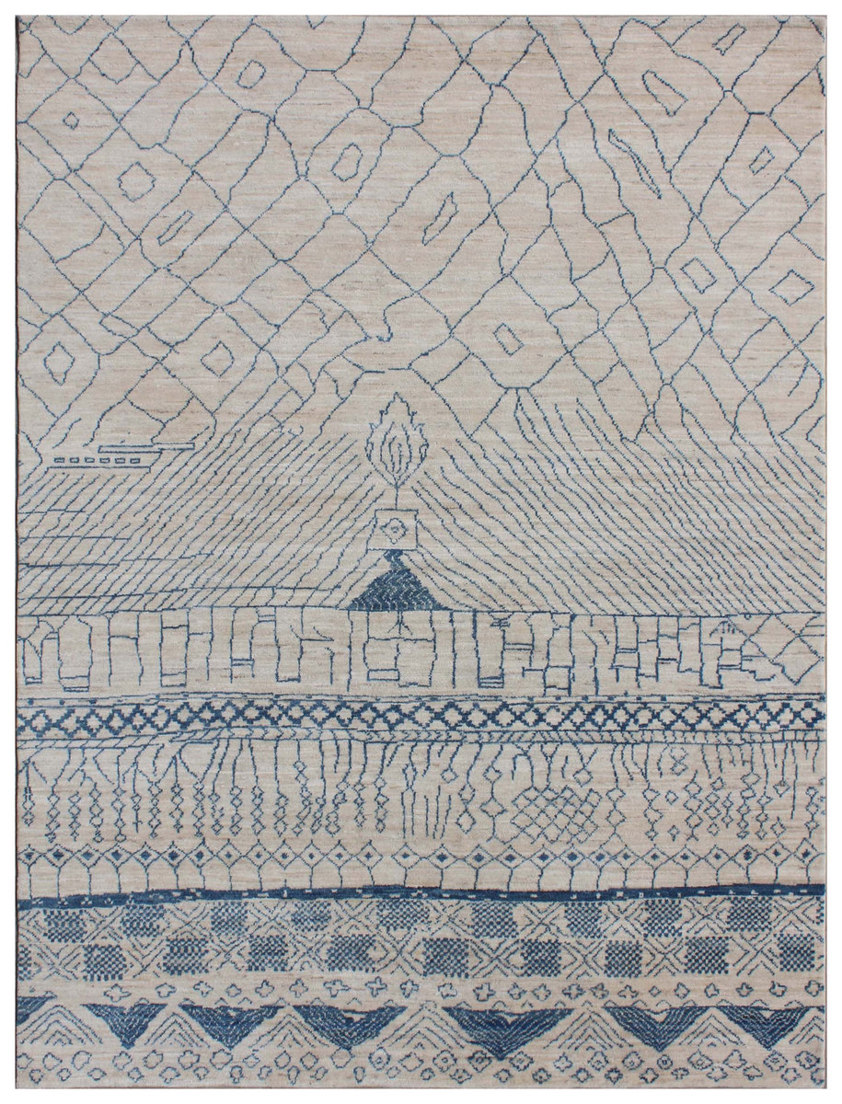
Fine blue lines wander across the cream upper field of this rug, meeting in irregular diamonds and open loops. Towards the lower portion, the drawing becomes more concentrated: slanting lines gather into a broad band, followed by small upright shapes, hanging lozenges and crosshatched compartments. Dark blue zigzags provide a stronger finish near the bottom edge. The composition is deliberately uneven in its distribution of detail. This rug's Berber style reference relates to the geometric textile traditions of Amazigh communities in North Africa, particularly those associated with Morocco's Atlas regions.
This is an Afghan interpretation, using a light ground and informal linear drawing to establish its own contemporary composition. The looser upper lines are balanced by much more closely ordered motifs below. The contrast between open upper field and denser lower bands is its most useful interior feature. At 229 × 165 cm, the lower bands would be effective in the space before a sofa, leaving the stronger pattern visible near its front edge. Plain upholstery would let the fine lines remain apparent, while a blue ceramic or textile could make a discreet connection with the drawing. The cream ground prevents the many small motifs from feeling crowded. Each band has a different pace, from loose diagonal marks to tightly repeated diamonds, so there is more to notice than a simple two-colour palette suggests. Pale timber would maintain its lightness, while darker fittings would bring the blue outlines into sharper focus.