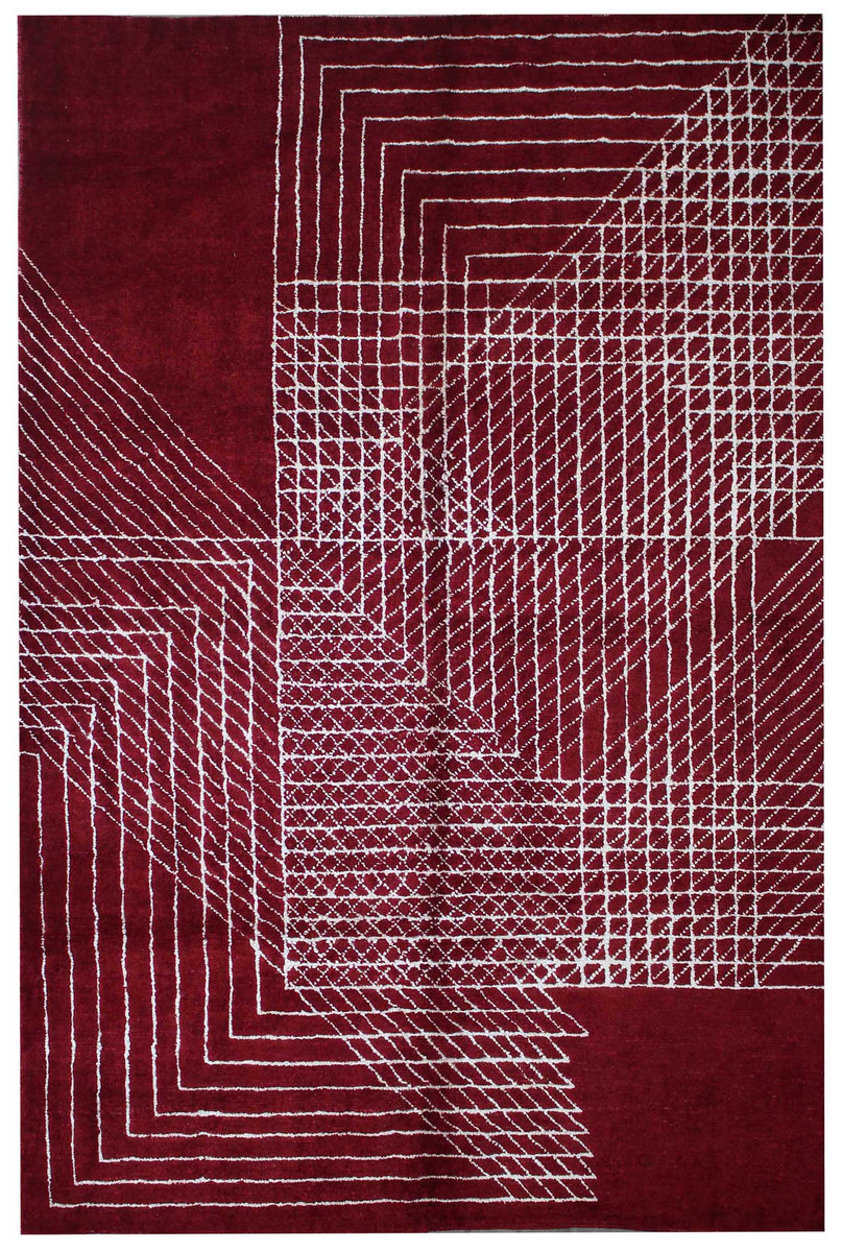
Pale angular lines stand out against the deep red field of this rug, building a composition of nested right angles and overlapping grids. Some groups remain widely spaced; others cross so closely that they create denser light passages. The red stays visible around and between them, giving the drawing a warm, strongly coloured setting. This rug would make a distinctive centre for a room with plainly shaped furniture.
Its 163 by 246 centimetre proportions could define a compact seating area, with the stepped forms extending around a low table. Cream upholstery would relate to the fine lines, while darker timber would connect with the depth of the red. The geometric structure is the whole design. This contemporary Afghan rug uses repeated parallel lines and changes of direction to create movement without a floral field or central medallion. The overlaps introduce a suggestion of depth, while open red areas keep the pattern from becoming equally dense throughout. Look closely at the intersections and each line can be followed through several turns.
From across a room, those detailed passages merge into larger pale shapes. That change of scale gives this rug much of its appeal, allowing a limited palette to produce a complex composition. It would reward a position where some of the middle stays exposed, preserving the meeting of the different grids and the broader stepped outlines that lead towards the edges of the field.