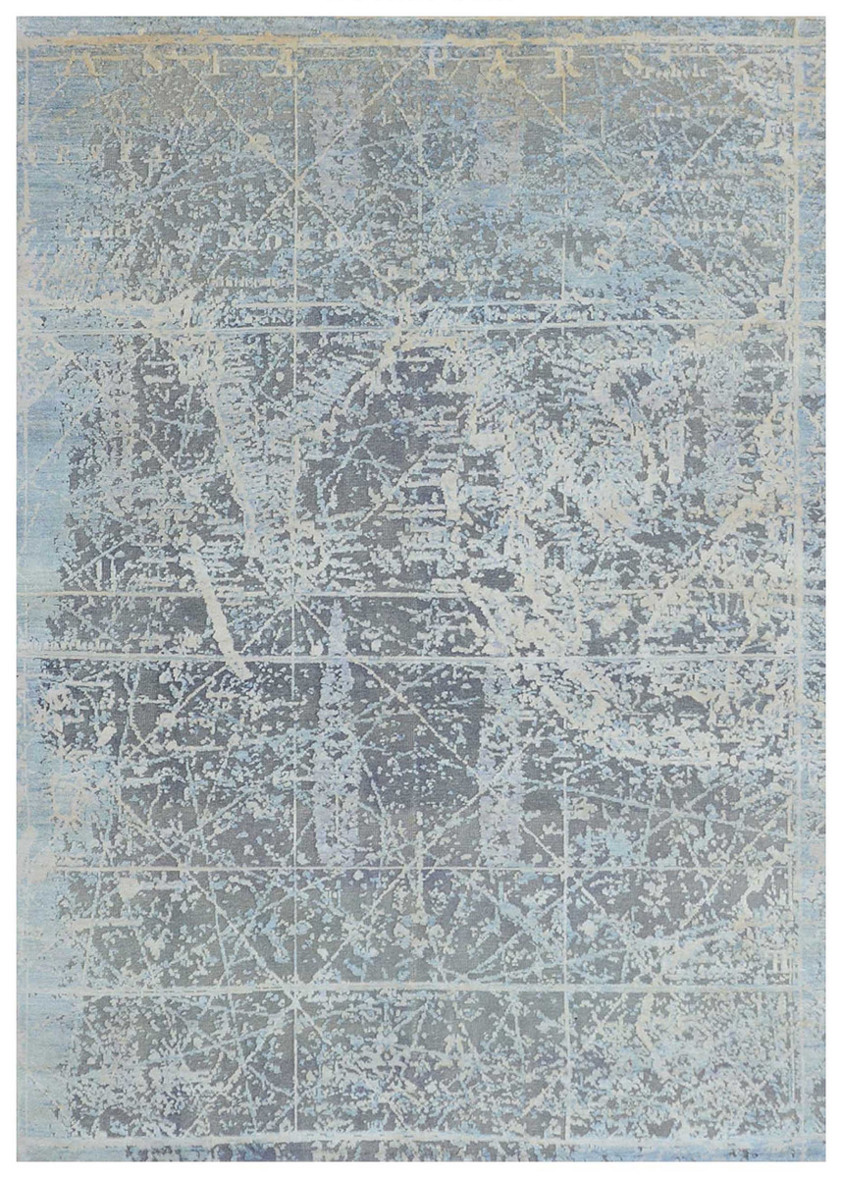
Fine abstract lines cross the blue-grey field of this rug, meeting softer pale marks and fragments of drawing. Some lines suggest rectangular divisions; others change direction or disappear into the background. The palette stays close, with cream, soft grey and pale blue providing gentle differences rather than strong contrasts. This rug would suit a room in which the floor needs a layer of pattern while remaining visually light.
Its 170 by 240 centimetre format could occupy the space in front of a sofa or an open bedroom area. Darker timber would give the pale field definition, while warm white textiles could connect with the finest lines. The fine marks in this contemporary Afghan rug favour interrupted geometry and a softly varied ground. The composition does not resolve into a single regular lattice. Instead, the fine divisions and scattered marks establish several areas of interest, with quieter passages allowing the larger arrangement to remain open. The drawing changes in visibility as neighbouring tones meet.
A pale line may be clear against grey, then become almost indistinguishable through a lighter section. That shifting clarity is central to this rug's character. From across a room, it reads mainly as a cool, restrained surface. Nearer by, the small geometric connections become more apparent, giving the field a complexity that is easy to overlook at first. Its appeal lies in those subtle relationships between line, interruption and open colour.