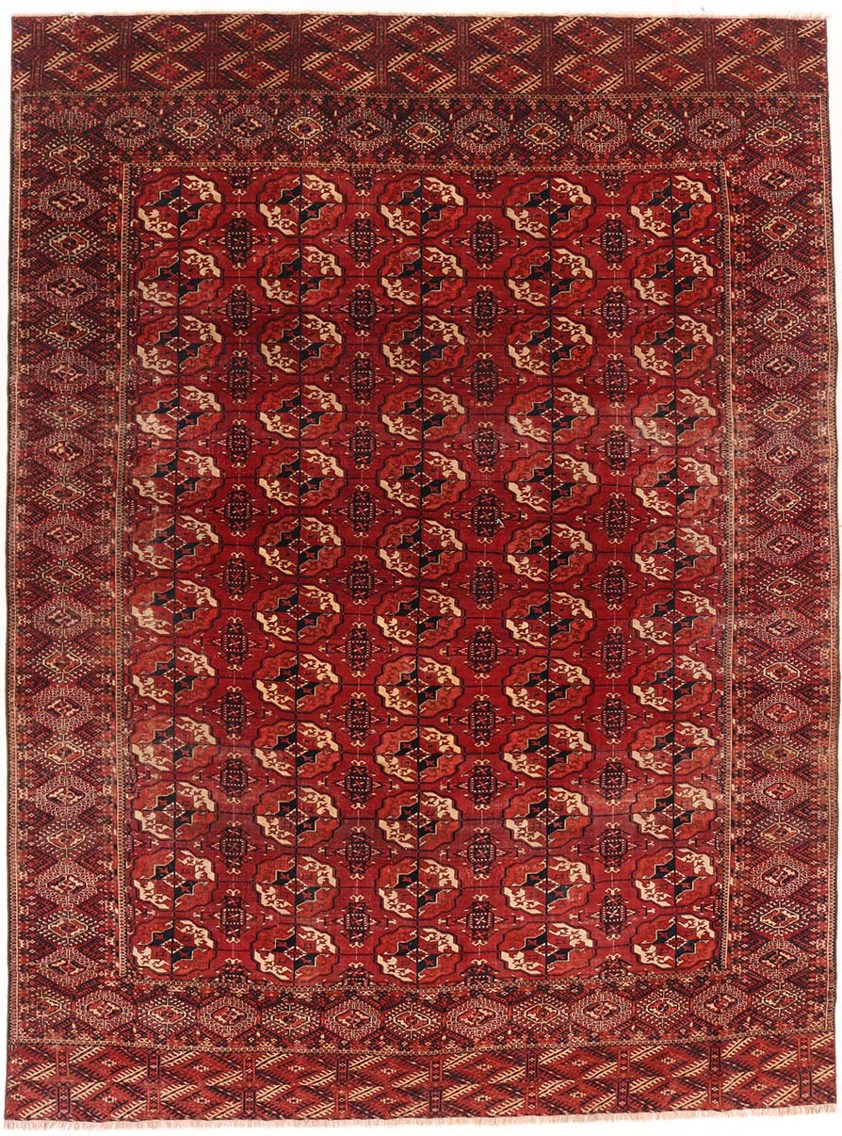
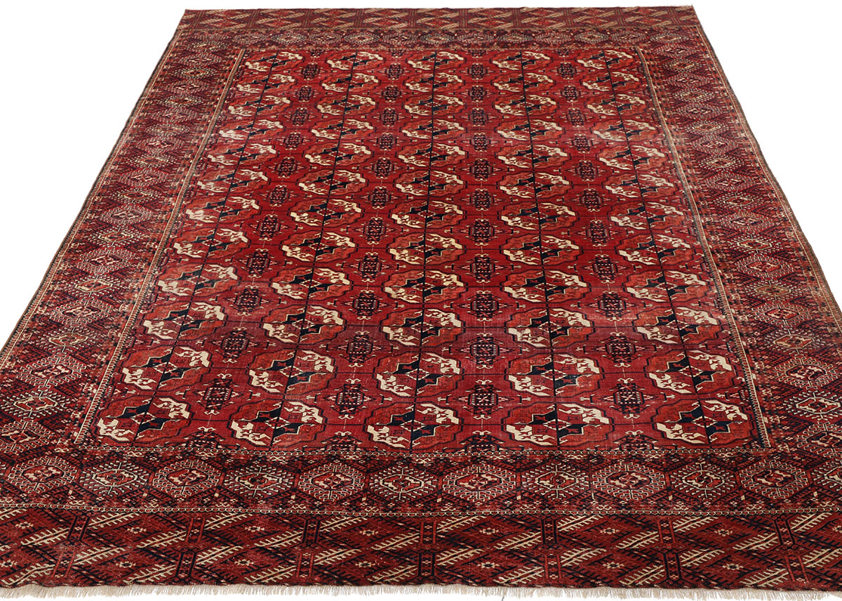
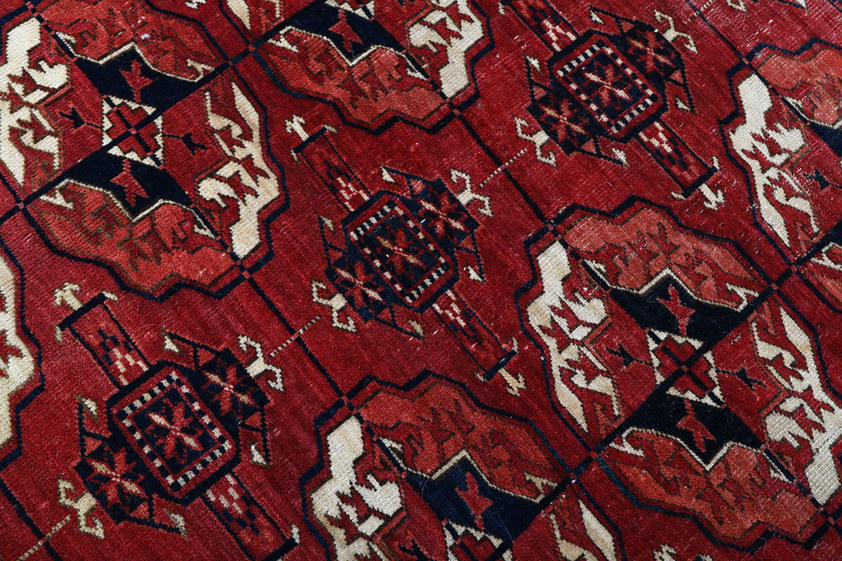
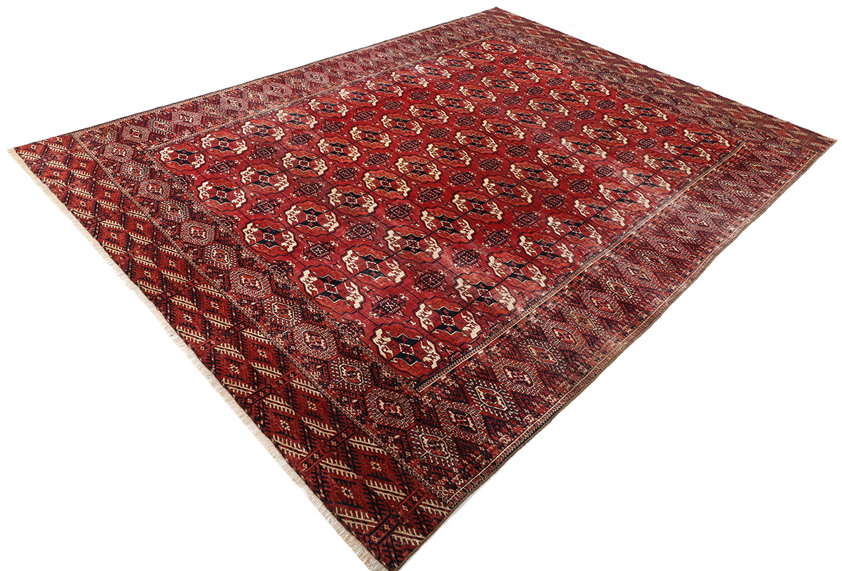
This Antique Tekke Turkmen rug, woven circa 1910, is a superb example of classical Central Asian tribal weaving, embodying the refined symmetry and disciplined geometry for which Tekke carpets are internationally renowned. The field is organised into a precise grid of repeated Tekke gul motifs — octagonal medallions that form the symbolic and cultural identity of Tekke weaving. These guls are rendered in deep madder red, ivory, charcoal and soft brown, creating a rhythmically ordered composition that is both powerful and harmonious.
The saturated red ground, achieved through traditional natural dyes, displays a rich tonal depth that has matured beautifully with age. Subtle abrash variations give the surface movement and texture, enhancing the authenticity and visual warmth of the piece. The clarity of the drawing and the disciplined repetition reflect the highly developed weaving tradition of the Tekke Turkmen tribes, where precision, balance and symbolism were central to design.
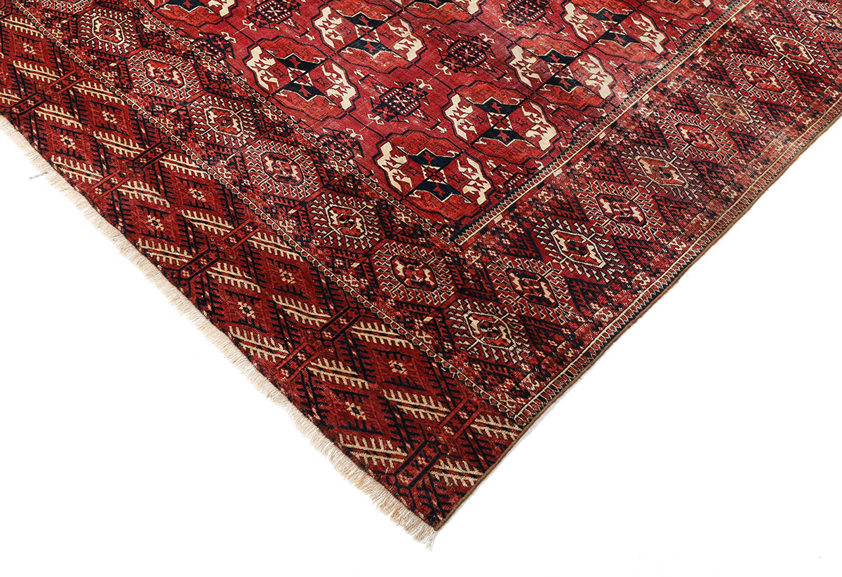
The borders are finely articulated, composed of multiple geometric bands that echo the motifs of the central field while providing strong architectural framing. Angular lattice patterns, small repeating emblems and linear guard stripes reinforce the rug’s structural integrity and visual cohesion. Hand-knotted in wool on a wool foundation, the rug possesses a dense, resilient handle, characteristic of early 20th-century Turkmen weaving, designed for longevity as well as beauty.
This piece functions beautifully as a formal living room rug, a study carpet, or as a strong anchor within a layered interior scheme. As a genuine antique Tekke Turkmen rug, it offers exceptional decorative authority, cultural significance and historical integrity, making it highly desirable for collectors and interiors that value classical tribal design, authenticity and enduring craftsmanship.