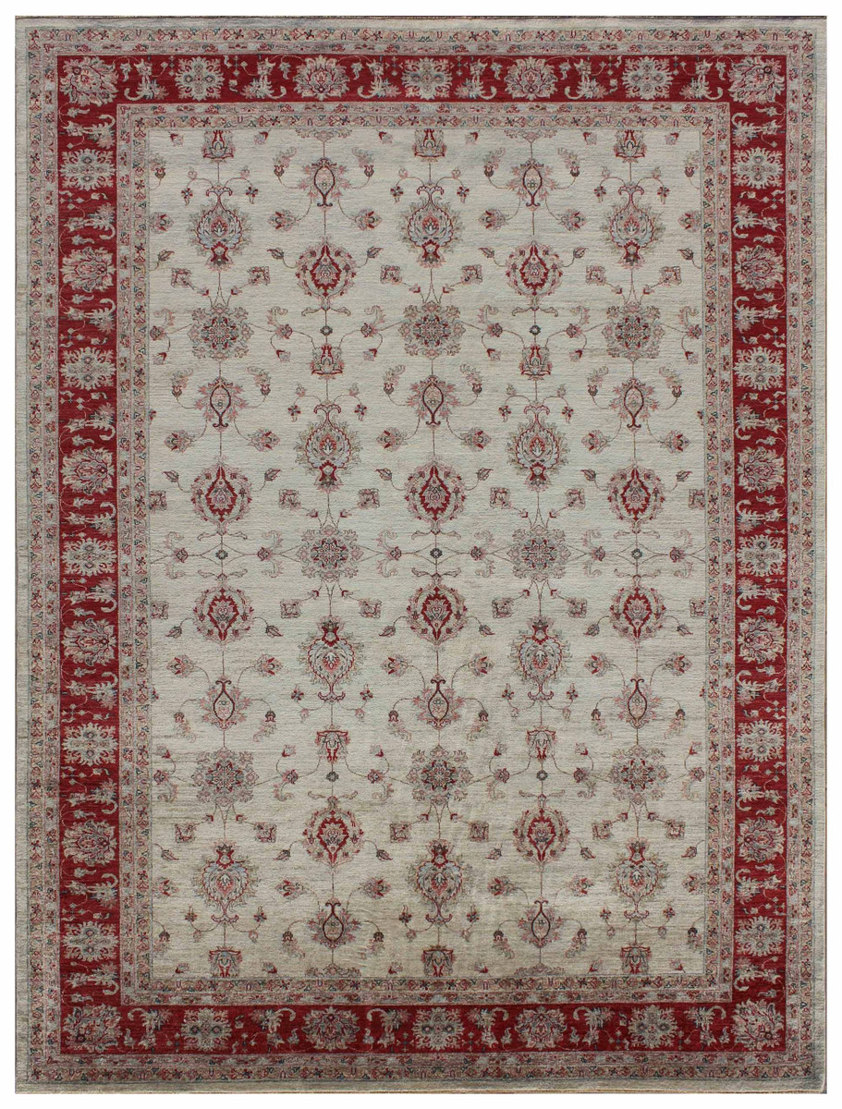
Small red floral forms repeat across the ivory field of this rug, linked by fine stems and scattered subsidiary leaves. The ornaments are relatively widely spaced, keeping the light ground clearly visible. A red border introduces a denser sequence of pale blossoms, giving the open centre a warm, firmly defined frame. The Zeigler name is associated with a design tradition deriving from the Ziegler firm's carpet production around Sultanabad in nineteenth-century Persia. Floral compositions adapted for domestic interiors became an important part of that heritage. This Afghan Zeigler rug interprets the vocabulary through a particularly light field and a repeated pattern of small, clearly separated botanical forms.
At 270 by 366 centimetres, this rug could anchor a generous living or dining room. A large table could occupy part of the middle while the surrounding repeat remains readable. Cream upholstery would relate to the ivory ground, while dark timber would complement the red. A little muted rose elsewhere could pick up the finer field details. The border is important to the balance of the whole design. Its pale flowers give the perimeter a different rhythm, while the narrow inner bands mark the change into ivory. From across a room, this rug offers a clear red-and-light arrangement. Nearby, the small stems and subsidiary blossoms become more apparent, giving the otherwise spacious field a finer level of ornamental interest throughout.